The complete story
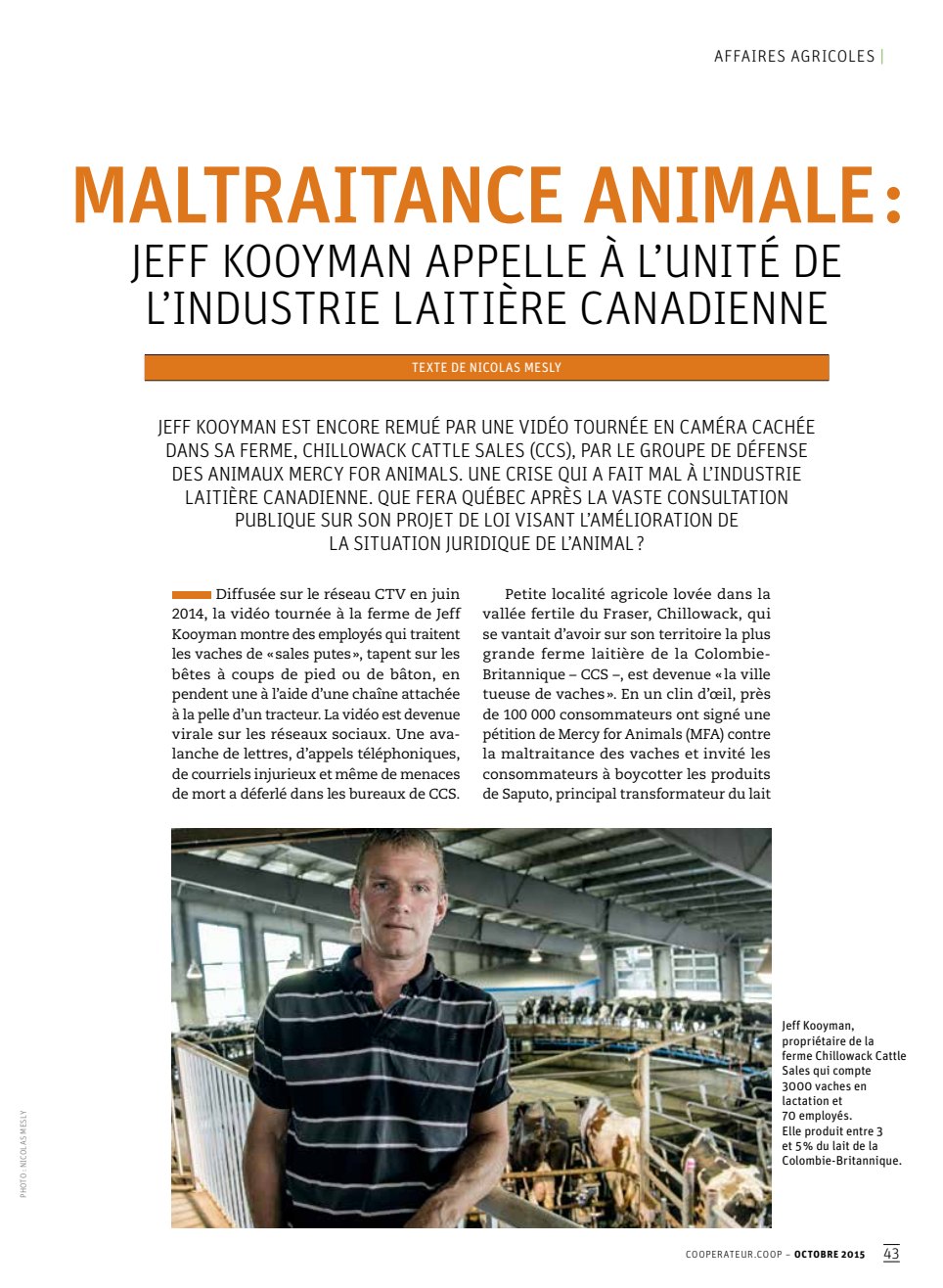
Jeff Kooyman, owner of Chillowack Cattle Sales farm, which has 3000 lactating cows and 70 employees, produces between 3% and 5% of milk from British Columbia. PHOTOS: LOUIS JACOB TEXT OF NICOLAS MESLY JEFF KOOYMAN IS INCLUDED BY A VIDEO SOURCE IN CAMERA CACHED IN HER RAIL, CHILOWACK CATTLE SALES (CCS), BY THE MERCY FOR ANIMALS ANIMALS ANIMAL DEFENCE GROUP. A CRISIS THAT MADE MAL TO THE CANADIAN LAITIER INDUSTRY.
WHAT WILL BE BE BE FOR THE FURTHER FOR THE PUBLIC CONSULTATION ON ITS PROPOSED LAW TO IMPROVE THE LEGAL SITUATION OF L-ANIMAL ? Aired on the CTV network in June 2014, Jeff Kooyman's farm video shows employees who treat cows as "sucking whores", kicking or sticking animals, hanging one with a chain attached to a tractor shovel. The video became viral on social networks. An ava - a web of letters, phone calls, abusive emails and even death threats ran through CCS offices.
PHOTO : NICOLAS MESLY ANIMAL MALTRAITANCE : JEFF KOOYMAN APPELLES TO THE UNITY OF THE CANADIAN MILITARY INDUSTRY Small agricultural community loved in the fertile Fraser Valley, Chillowack, who boasted of having on his territory the largest dairy farm in British Columbia – CCS –, became "the cow-killing city."In a wink, almost 100,000 consumers signed a petition from Mercy for Animals (MFA) against cow abuse and invited consumers to boycott the products of Saputo, the main milk processor 43 COOPERATOR.COOP – OCTO BREAKER 2015 AGRIColes AFFAIRS, Jeff Kooyman wants to give his ver sion of the facts, after having been crushed by the media machine. 44 COOPERATOR.COOP – OCTO BRE 2015 of this farm.
However, Jeff Kooyman, who was interviewed in CCS's offices, continues to say that "his cows are among the best treated in the country." A BLACK BLACK WEARER Jeff Kooyman is the media figure of a crisis that has given a black butter eye to a dairy industry representing $19 billion of the country's GDP, a crisis that will transform the practices of some 12,000 Canadian farmers, nearly half of whom live in Quebec. This producer runs the family farm with his seven brothers. "The Kooyman clan" transformed the small fatherly business of 60 cows in its early 1960s into a megafarm of 3,000 cows in lactation.
CCS has 70 employees and produces between 3 and 5% of the province's milk. All eight of the night crew's filmed employees were dismissed. Without wishing to excuse their behaviour, the producer describes them as "good little guys from the village who made a youth error." Yet they are subject to criminal charges.
Jeff Kooyman agrees to host us - to have an interview with Diana Barchard, the company's financial director – despite the contrary advice of his lawyer. He wants to give his version of the facts, after being crushed by the media machine. Within days of the release of the video, brigades of experts and independent veterinarians arrive at CCS, to check the state of the place. The British Columbia Milk Marketing Board (BCMB) initially refuses milk from the "damned" farm.
"After we were satisfied that the milk produced at CCS was in accordance with the Code of Practice for the Care and Handling of Dairy Cattle, we had to redirect the milk refused by Saputo," explains Vicki Crites, Communications and Public Relations Manager at BCMMB. "The milk from the megafarm was sent to a biodigester located in Washington State, for a cost of $200,000, absorbed by all producers. "We have been able to get the milk from the dairy farm to the market and to the market and to the market.
MORE TO THE BCMMB Since September 2014 – three months after the video was released – the Code of Practice for the Care and Handling of Dairy Cattle, published in 2009 by the National Council for Livestock Care, has become mandatory in British Columbia (it was previously a volunteer). And it is the BCMMB, mandated by the provincial government, that ensures that everything is done in the art of the 500 producers in the province. To date, the organization has recruited six inspectors to do this.
And five surprise visits were made to CCS, without any deviations being detected. Vicki Crites states that the Code of Practice is intended to protect animals, but "does not affect cruelty to animals. However, if our inspectors find cows in distress, because they are not fed or without water, we can immediately suspend the collection of milk and even revoke the producer's licence." In addition, an agreement was reached with processors that will no longer be able to refuse milk from producers who comply with the Code, as was the case with Saputo.
LESSONS RECEIVED FROM KOOYMAN CLAN Since the scandal, CCS has appointed a Director of Human Resources. All employees receive three-day training and now work under the watch of a supervisor. Surveillance cameras have also been installed in the buildings. "We can monitor what is spent 24 hours a day from our cell phones," says Jeff Kooyman. "45 COOPERATOR.COOP – OCTO BREAKER 2015 The practice of lifting a cow stuck in the carousel using a tractor is now prohibited.
Seven men with straps are now needed to move a beast of more than 600 kg. Yet, according to the breeder, the old method, endorsed by his own veterinarian, is common and did not hurt the animal. According to him, the criticisms about his breeding practices made by independent veterinarians in the wake of the scandal are summed up by the fact that the density of animals was slightly high. MALGREED THE CODE, IT WILL MAKE UP BLANCHE PATTE If the Code of Practice deals with painless debarring of calves or with cutting the tails of cows, "Canadian farmers will have to do much more to eliminate the lameness of their cows.
This is their biggest issue!" warns Dr. Anne-Marie de Passillé, professor of animal welfare at the University of British Columbia. Rebelled by the video tour at CCS, the expert, based in Agassiz, a village just 70 km from Chillowack, said she had never visited the company. However, her observation of the problems of lameness comes from a pan-Canadian study conducted among 110 dairy farmers in the country.1 The Canadian Dairy Farmers' Code of Practice recommends an ideal rate of lameness of less than 10%.
However, less than a quarter of the free-standing stables visited by his team met this goal. Jeff Kooyman admits that the problem of lameness exists, but not in his breeding, which is contradicted by the video footage. He was an employee who worked for CCS for a month in May 2014 and shot the video in this company. He was actually an "investigator" working for MFA.
The headquarters of this animal-defence organization is in Hollywood, California, and its website promotes vegetal and vegan food."Chillowack is our eighth survey in Canada," says Krista Osborne, Canadian director of the organization since January 2015. Does the Kooyman clan envisage prosecution of its employees for violating the company's reputation? "This is done in some American states, where it is possible to sue an employee who is being hired on a false basis.
But all this family wants is to turn the page," says Barchard. Jeff Kooyman says he is deeply struck by the initial reactions of the BCMMB, then Saputo, "who folded under the MFA lobby." In June 2015, the first Canadian processor announced that he was implementing his own animal welfare code in the four countries where he owns plants. Jeff Kooyman believes that the Canadian dairy industry would have more to gain by presenting a united front against the issue of animal abuse.
"What happened to us can happen to any other breeder," he adds. "Quebec has already had its Chillowack," says Sophie Gaillard, when Mercy for Animals released a video on the abuse of milk calves shot in a farm at Delimax in April 2014. Lawyers for 1 How are Canadian farms doing in terms of cow comfort and beauty? Dairy Cluster Project on cow comfort and longevity, Anne-Marie de Passillé, Ph.
D., Laboratory of Ethology, Agriculture and Agri-Food Canada, 2012 Bill 54, FEDERAL COOP AND OLYMEL PRONOCATE On Tuesday, September 15, La Coop fedérée and its limited partnership, Olymel, each tabled a submission to the National Assembly in the course of parliamentary consultations on Bill 54. This bill aims to give animals the legal status of sensitive and biologically imperative animals. Several of the provisions relate to the company's activities in the areas of livestock, transportation and slaughter.
The Federal Co-op and Olymel welcome this bill because they believe that well-being is also synonymous with productivity and profitability, but they have made a few recommendations, mainly with a view to having regulations that do not compromise the competitiveness of the industry. We can consult the submission of La Coop fedérée on the site: cooperateur.coop - Section Economic Affairs VACHES MALTRAITANCE: WHAT WILL QUEBEC BE? Since the scandal, CCS has appointed a director of human resources and surveillance cameras have been installed in the buildings. 46 COOPERATOR.COOP – OCTO BREAKER 2015 PHOTO: ÉTIENNE GOSSELIN PHOTO: INGIMAGE animal defense at the SPCA in Montreal, Gaillard represents the Animal Legal Defense Fund, which has ranked Quebec, three years in a row, among the last good in Canada in terms of animal protection laws.
To stem this bad reputation, Quebec's Minister of Agriculture, Fisheries and Food, Pierre Paradis, launched a broad public consultation on his bill this fall.54 The purpose of this project is to stop consid rating animals as "movable goods" but as "sensi ble beings with biological imperatives." The question remains whether Minister Paradis will make the Code of Practice for the Care and Handling of Dairy Cattle mandatory without any further mention, through the provincial milk marketing agency, the Quebec Milk Producers, as is now the case in British Columbia.
At their annual meeting in Vancouver last July, the delegates of the Dairy Farmers of Canada (LAC) unanimously voted for the adoption of the ProAction program, which includes a cow welfare component. Voluntary over a two-year period, the ProAction program will become mandatory only in 2017. "The goal is to ensure that the animal welfare component is adopted by producers, as was the quality milk component of the ProAction program," explains Pierre Lampron, a member of the PLC Board of Directors and responsible for animal welfare.
Launched eight years ago, the quality milk component is adopted by 97% of the country's producers. Today, there are about 100 recalcitrant producers on the 6000 farms in Quebec, according to Pierre Lampron. They are fined between $2 and $8 a hectolitre. WHO WILL BE INSPECTIONS OF ANIMAL WELFARE AND WHAT COST?
At present, it is not known who will be approved to conduct inspections to ensure that good practices for the care of dairy cattle are respected. This mandate could be entrusted by the Quebec Dairy Producers to the private sector (veterinaries, Valacta staff, Holstein Canada classifiers...). "We would prefer that these inspections be carried out by MAPAQ inspectors," says Sophie Gaillard. However, in order for the animal welfare inspection system not to be too expensive for producers, it will be necessary to "be credible," says Pierre Lampron.
"If the code is mandatory and you find yourself with a farmer, 80% of the cows are limping, what do you do?" he asks. "And Pierre Lampron applauds the animal welfare program adopted by the country's largest dairy processor, Saputo, and modelled on the Code of Practice for the Care and Handling of Dairy Cattle."It's going to put pressure on the breeders, because Saputo has to be accountable directly to consumers," he says. "We're not going to be able to do that," he says. "We're going to be able to do that."
According to Ms. Sophie Gaillard, one of the intrinsic conditions of animal welfare is that a beast must be able to express its natural behavior. Is the happiness of cows in the meadows? In the stables attached? In the stables with free stabulation?
The work of Minister Paradis' parliamentary committee may answer the question. The Dairy Farmers of Canada Code of Practice recommends an ideal rate of lameness of less than 10%. However, in her pan-Canadian study, less than a quarter of the free-standing stables visited by Dr. Anne-Marie de Passillé and her team met this goal.
Complete original publication
The complete facsimile presents the publication in its original editorial design.
Open original PDF ↗