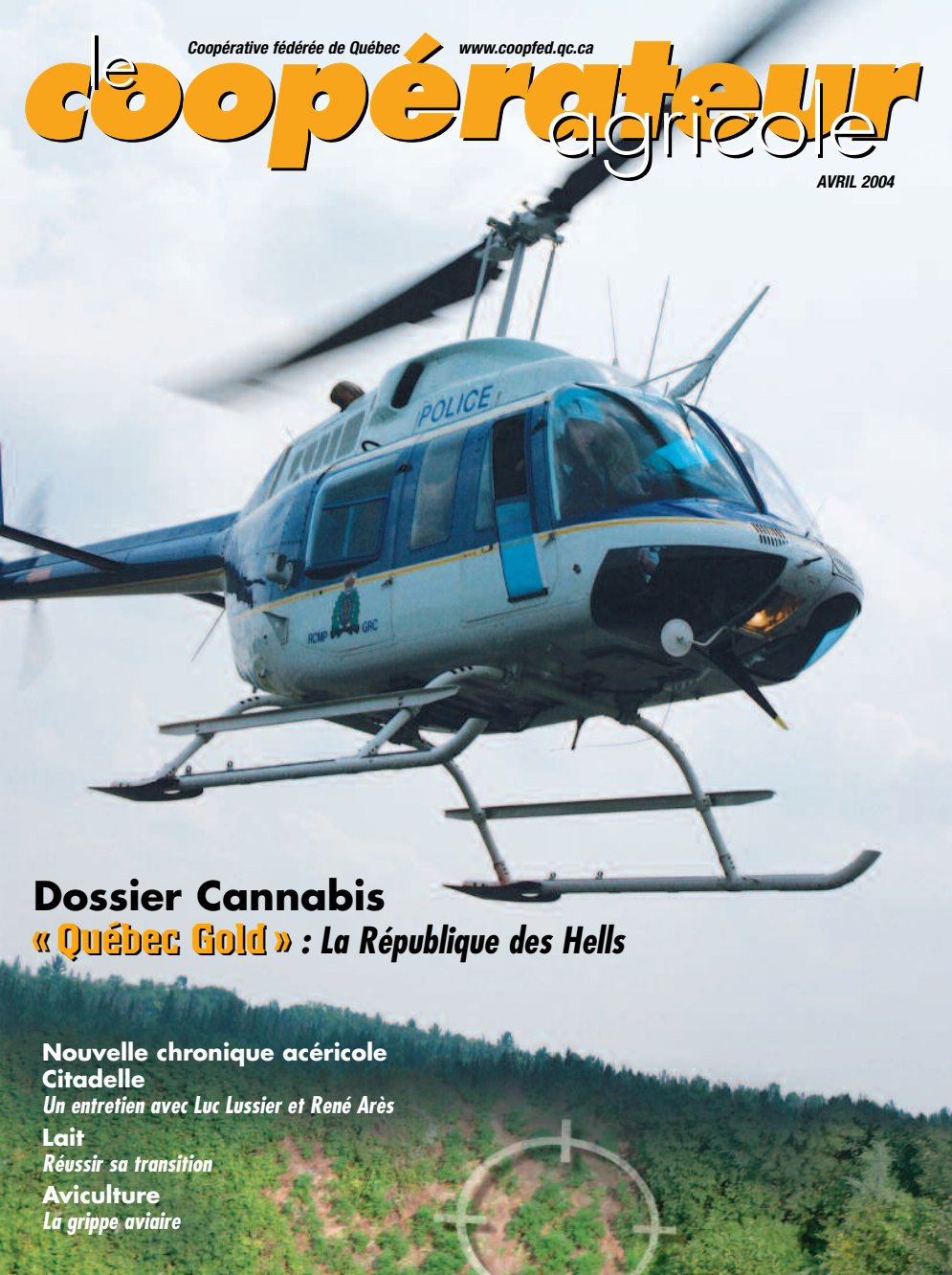
The complete story
www.coopfed.qc.caCoopérative fedérée de Québec APRIL 2004 Cannabis file "Québec Gold""Québec Gold": The Republic of Hells New maple column Citadelle An interview with Luc Lussier and René Ares Lait Successful transition Aviculture Avian influenza AGRICULTURAL CO-OPPERATOR – APRIL 200450 APRIL 2004 – THE AGRICULTURAL CO-OPERATOR 51 The illegal cultivation of cannabis would cost between $5.5 billion and $11 billion per year.
According to the RCMP, the Hells Angels control the distribution of this industry in the black across the country and their power grew with the "Quebec Gold", a variety of marijuana grown in the corn fields of the province. Should the "pot" be legalized to cut grass under the foot of the traffickers? The Republic of Hells "Quebec Gold" Text by Nicolas Mesly YVAN LOUBIER , Bloquist MP for Saint-Hyacinthe-Bagot file _______________________ 1.
The RCMP estimates annual cannabis production at 800 tonnes since 1997. No one can estimate the production or exact value of this industry in the dark. However, the value of plants seized in Canada would be more than $2 billion. The very serious magazine Forbes estimates the value of this illicit trade between $5.5 billion and $11 billion.
"No question of intimidation. I will not live in a Republic of Hells!" The launch of Operation Squad orchestrated by the Sûreté du Québec on June 25, at the lende - hand of Saint-Jean-Baptiste, the Bloquist MP for Saint-Hyacinthe-Bagot, Yvan Loubier, urges his fellow citizens to denounce "the potty" squatting the fields and woods of the MRC des Maskoutains by calling anonymously to the number Info-crime 1-800-711-1800. The purpose of Operation Squad: to remove the most cannabis plants from the market.
Yvan Loubier made the war on marijuana his battle horse. In 1998, he demonstrated, with aerial photographs in support, the transformation of the Quebec Corn Belt into Pot Belt. A public exit that will be worth the ex-CEO of the Union of Agricultural Producers (UPA) and his family to live two and a half months under the protection of the Royal Canadian Mounted Police (RCMP), after receiving two calls of death threats attributed to the infamous group of criminalized bikers, the Hells Angels. For "Mr. Cannabis", who admits to smoking a joint in his youth, the "pot" no longer symbolizes the Peace & Love era of the 1970s.
Marijuana would have become a "hard drug" that symbolizes today a money war where "the future of our children is at stake!" And it advocates the muscular intervention of the army, "as in the United States", to exterminate the scourge once and for all. PHOTO: NICOLAS MESLY "No question of intimidation. I will not live in a Republic of Hells!"
PHOTO: SAINT-HYACINTH APRIL 2004 – AGRICULTURAL COOPERATOR 53THE AGRICULTURAL COOPERATOR – APRIL 200452 Quebec holds nearly half of the number of plants seized in the country by British Columbia. A record! 648,000 plants in 2001, more than 524,000 in 2002, idem in 2003 2. Street value: $1 billion! The flourishing marijuana crop has partly abandoned the thermal units and camouflage of its cousin, corn, to invade the fields and forests of AbitibiTémiscamingue and Lac-Saint-Jean.
And it grows year-round under artificial tropics, sheltered from inquisitorial eyes, in an innumerable number of residential houses transformed into hydroponic or aeroponic greenhouses. L'invading marijuana cultivation poses a huge societal problem. And the debate can no longer be stifled."Genetic progress on cannabis is comparable to the development of GM maize!
But it doesn't make a pot a hard drug like cocaine or heroin. It's the same plant as 30 years ago," explains Alain Berthiaume, editor of Cannabis Québec magazine. THC's level, the euphorizing substance of cannabis available on the market, would vary between 6% and 31%, while in natural condition the plant contains less than 3%.3 _____________________________ 2. The RCMP indicates that the 2003 statistics are similar to those of 2002 (see graph on page 71). 3.
Le Cannabis: Positions for a Public Policy Regime for Canada, Report of the Senate Special Committee on Illicit Drugs, September 2002. Inveterate smoker, Berthiaume preaches for the legalization of the "recreational seal." Amount of followers, adults and vaccinated, he says, smokes pot home grown, sitting peperas in their living room, without being "criminals" or "attracted suppliers of the Hells."The Prince of the Pot" Quebec operates a cannabis seed bank that gables on Monk Street in Montreal.
It offers its customers no less than 250 species of cannabis varieties imported from all over the world, including Holland and the United States. The "Quebec Gold", with its real name Freezeland, which colonized the corn fields of the province, is a mixture of two strains of cannabis Sativa and Indica. The "Quebec Gold" and "BC Bud" are today a kind of uncontrolled appellation of all varieties produced in greenhouses or outside that are found on the market. War on the illegal consumption and cultivation of cannabis, from seed to joint, has this paradoxical.
Any person can become small or large mariculteur by freely supplying seeds and specialized equipment. Terrestrials, lamps of 400 to 1,000 watts, fans, chemical fertilizers, organics, etc. Sellers of hydroponic or aeroponic cultivation equipment are spreading in Montreal and the provinces as well as Toronto and Vancouver. Moreover, nothing is easier than becoming an expert gardener.
The Internet is a network of as many as 1,000 websites where you can take a 101 course on cannabis cultivation, not to mention a galaxy of literature available on the shelves of specialized stores. However, as soon as you wear a joint to your lips, you live in lawlessness. If the police don't arrest all consumers, it's because they're overwhelmed. Canada has one to two million husband smokers.
Every year between 20,000 and 50,000 Canadians are arrested for simple possession of cannabis, all of them are killing the justice system, and nearly a million Canadians have a criminal record. With such a tattoo, it is impossible to travel to the United States or get the job of his dreams in the North American free trade.
North American demand for quality pot is amazing. There is even a "pot" exchange on the Internet. Prices reach the seventh sky."The price of a pound of BC Bud goes from $3,000 to $5,000 per pound, as soon as it crosses the American border.
The average price of a book of "Quebec Gold" produced outside is $2,150; in a greenhouse, $3,250. The farther the pot is to the south, the more the pot is worth, up to $7,000 per pound," explains Jean-Pierre Lévesque, coordinator of special projects at the Canadian Criminal Intelligence Service. Aboriginal Chief of Police C. Gorden McGregor (on the far left) asked the RCMP and the Canadian Army for assistance in eradicating cannabis plants near Kitigan Zibi Indian Reserve in the La Vérendrye Wildlife Reserve, after receiving a clear mandate from the Band Council.
Operation Cactus, led by Sergeant Noel St. Hilaire (in the centre), on August 5, resulted in the eradication of 1,200 plants, a minority of traffickers living as millionaires on the reserve, who are soaking up marijuana trafficking after having hand-made cigarettes smuggling on the US-Canada border.
"Our investigations lead to Hells Angels," says Mr. As in rural communities, cannabis poisons the lives of reserve residents. Alain Berthiaume operates a cannabis seed bank on Monk Street in Montreal offering more than 250 varieties to his clients. The war of cannabis, from plant to plant, has this paradoxical.
Anyone can become a mariculter expert, small or big. The sale of equipment and specialized books is free. The "Prince du pot québécois" spent four months in prison in 2003 for organizing the Cannabis Hashich Cup from 1998 to 2001, an event inspired by Holland. In the event of the legalization of the pot in Canada, the police authorities feared the invasion of narcotourists.
PHOTO: NICOLAS MESLY PHOTO: NICOLAS MESLY AGRICULTURAL CO-OPPERATOR – APRIL 200454 According to RCMP 4, the Hells Angels control the distribution of marijuana across the country. Small and large mariculturers work as subcontracts for the group of criminalized motorists. Covenants are made, notably with Vietnamese criminal groups for the domestic culture of "BC Bud" in British Columbia, but also in Toronto, Ottawa and Montreal. Illegal immigrant cells, a pool of submissive labour, grow green gold from the Hells.
However, "no one knows the true percentage of marijuana production under the supervision of organized crime and that held by small producers who provide their circle of friends," says Daniel Sansfaçon, Assistant Director General of the Montreal-based International Centre for Crime Prevention. The largest seizure by the SQ in agricultural territory was 552 plants in 2002, but police officers invest plantations on National Defence lands and even 5,000 to 10,000 plants on Crown land.
True "paddy fields" grow along rivers in national parks, some of which are planted with spruce-coloured cannabis varieties to avoid aerial detection. Other "boosted" varieties in indoor greenhouses allow for a first harvest in six weeks. A house turned into a greenhouse can earn $1 million for an investment of $50,000.
Fifteen thousand officers from the Sûreté du Québec participate in this northern zafra. Not to mention the support of the municipal police, the Aboriginal police, the RCMP and the Griffon helicopters of the Canadian army. Despite all these efforts, the price of cannabis on the street does not brow. And a marijuana seal is also available in the secondary schools as well as aspirin at Jean Coutu. ________________ 4.
Canada at War on Outlawed Bikers' Bands, La Gazette, RCMP, Vol. 64, No. 3, 2002. The Culture of Marihuana in Canada: Current Trends and Trends, November 2002, Criminal Intelligence Directorate, RCMP. Billions of dollars have been swallowed to reduce supply. Yet cannabis is more available than ever, widely grown and even exported," said Conservative Senator Pierre Claude Nolin, author of a detailed report on illicit drugs tabled in the Canadian Parliament in September 2002. 5.
The conclusions of the very controversial Nolin report, which wants to put the clock on the clock: the war on cannabis is a blow to police budgets. "How far can we go?", pot smokers are not bandits or addicts, the use of cannabis does not automatically lead to sniffing coke or to heroin-stinging. Compared to cigarettes or other psychotropic drugs, marijuana creates less habituation, no matter how strong it is. Between 5 and 10 per cent of consumers are dependent.
The physical and psychological dependence on marijuana is low to moderate. While for cigarettes it is high to very high. And for alcohol it is very high. Given the level of carcinogenic chemicals, cannabis can also cause lung disorders, but if the product is inhaled in very large quantities over a very long period of time 6.
Senator Nolin is proposing to legalize cannabis, such as alcohol and tobacco. To create a Society of Alcohols and Drugs (SAD), while focusing on education and prevention among youth. Is marijuana used in teens? No, the honourable senator says, "it would be ostrich."
"Fifty percent of young Canadians smoked pot at least once between the ages of 12 and 17 years, and parents have an important role in educating them at this stage of life." In both the licit and illicit drug sector, Canada "does not have a real national strategy except for a patchwork of disarticulated approaches" under the leadership of one department, Health Canada. "Cannabis is a great case of the drug industry, when it is well known that alcohol kills more Canadians than illicit drugs."
Because of the importance of the issues, Nolin proposes to open the debate with branches planted in all areas according to their fields of competence: provinces, territories, municipalities, community organizations, the private sector to guide society. And to forge a national compass with real financial means and appropriate tools. Among these, the creation of a Canadian Observatory on Psychoactive Substances and Addictions to probe the adult and student population every two years.
According to the honourable senator, the current ban on cannabis is pushing teenagers into the hands of small street dealers whose drug quality is questionable and "who have other substances to offer." One of the "inevitable" consequences of creating a DSS would be to cut grass under the foot of traffickers."Criminals rub their hands with prohibition," he adds, tracing a parallel to illegal alcohol trafficking in the 1920s-33s. Nolin praises the work of the police officers who are on the first line of fire in the cannabis war.
But by ceasing to consider cannabis as "hard drugs," they could target their efforts at the big traffickers. Nolin concedes that the creation of a DSS would not completely stifle the black market and trafficking. And that such a project is "heretic" without the blessing of the Americans and the rest of the world. Cannabis became illegal in Canada in 1923 and then, outside international law when a United Nations convention was adopted in 1961, under American leadership.
The Nolin report was on the desk of former Prime Minister Jean Chrétien, one and a half years after a study by Léger Marketing (June 2001) indicated that 46.8% of Canadians and 52.7% of Quebecers believe that the federal government should legalize the sale and use of cannabis. ________________ 5. Le Cannabis: Positions for a Public Policy Regime for Canada, Report of the Senate Special Committee on Illicit Drugs, September 2002. 6. Canadian Broadcasting Corporation, Le Point, 2, 3 and 4 September 2003.
"The war on cannabis is causing more harm than the drug itself," said Conservative Senator Pierre Claude Nolin, author of a detailed report on cannabis tabled in the Canadian Parliament in September 2002. "Nolin is proposing to legalize cannabis by creating a Society of Alcohols and Drugs. Nothing new in this project. In 1972, more than 30 years ago, the Parliamentary Commission Le Dain made the same recommendation.
The honourable senator compares the current situation of cannabis at the time of the prohibition of alcohol in the 1920s-33s and asks Canadian legislators to inhale a breath of common sense."PHOTO: ARCHIVES DU SE NATOR NOLIN PHOTO: ALAIN BERTHIAUME APRIL 2004 – THE AGRICULTURAL COOPERATOR 57THE AGRICULTURAL COOPERATOR – APRIL 200456 The project of a Society of Alcohols and Drugs north of the 45th parallel risks not seeing the light of day tomorrow morning."Decriminalization and not legalization," countered former Prime Minister Jean Chrétien in response to the recommendations of the Nolin report, quickly tabled on a tablet.
The announcement of the Canadian marijuana bill was made in Washington last spring under the watchful eye of President Bush's Tzar John Walters. Because Americans fear being flooded with "Quebec Gold" or "BC Bud." Ninety percent of current Canadian production would be exported to the United States. A few years ago, Washington officials had turned Canada into "North Colombia 7" and the country could add to the unenviable list "of countries suspected of laxism in the fight against drug production and trafficking."
The average annual marijuana seizures at U.S. borders over the past five years have been 271 tons, with the largest providers being Colombia, Mexico and Jamaica."In 2000, marijuana seizures from Canada accounted for 0.3%," says Jack Reed, of the U.S. Bureau of Criminal Statistics, who does not have more recent data from federal authorities on the percentage of Canadian marijuana seizures."The Canadian bill meets the expectations of the Bush administration that curses marijuana.
He falls into the rhetoric of war on terrorism of major agencies such as DEA," says Paul Armentano, author of an extensive study on the American cannabis industry on behalf of the Norml Foundation. The organization has been campaigning for 30 years for legalizing marijuana in a nation struggling "with deep psychosis."8 _______________________ 7. Canadian pot dealers are nicknamed the Colombians of the North, La Presse, 26 May, 2000. 8. More reefer madness, The Atlantic Monthly, April 1997.
SQ officers in plain clothes rip plants out of a field near Oka. The cannabis plant has been cultivated since the dawn of time. It was considered "the plant of joy" during spiritual ceremonies by Chinese, Indian and Middle Eastern tribes. Cannabis became illegal in Canada in 1923 and outside international law in 1961.
Jean Chrétien PHOTO's political legacy: NORMAND BLOUIN, AGENCY STOCK APRIL 2004 – AGRICULTURAL COOPERATOR 59THE AGRICULTURAL COOPERATOR – APRIL 200458 Originally from California, the Hells Angels ruled as masters in Quebec from 1994 to 2001. The bloody war between the Hells Angels and their sworn enemy, the Rock Machine, for the control of narcotics in the Island of Montreal killed 163 people. Despite the arrest of the "Prime Minister of the Hells", Mom Boucher, and the major police raids Spring 2001 and 2004, the Omerta law still reigned in the countryside.
And the profits of cannabis are still turning the Hells machine. PHOTO: YVAN TREMBLAY, GRACIOUSTY OF MICHEL AUGER The United States, world champion of the drug war, spends between $35 and $40 billion a year to cut short the amazing bulimia of their taxpayers. This does not prevent marijuana from being the first cash crop in the country. At the price of an ounce sold on the street, cannabis is worth twice as much as the country's main legal production, corn, or $44 billion.9!
In Uncle Sam, cannabis, as in Canada, is the third most popular drug after tobacco and alcohol. More than eighty million Americans admit that they have already smoked pot, including the former President of the United States, Democrat Bill Clinton, saying, "not to have inhaled." Twelve million people would use it regularly. And, in the country of zero tolerance, marijuana is also the favourite drug for young Americans.
Over five million Americans have been arrested in the last decade on charges of marijuana, and almost 90% of these arrests are for simple possession, not for trafficking or sale. Prisons are full of cracks. And the prison population, all of which are kept, is mostly composed of black minorities and Latinos.
For tax purposes, California, the first producer of outdoor pot, was also the first of twelve states in the United States to decriminalize the simple possession of marijuana. Decriminalization is defined as severe penalties for producers and traffickers. But no jail or criminal record for someone who is arrested for the first time with a small amount of marijuana. Instead, police officers are fined like overspeed tickets.
The Californian state has been growing nearly $100 million a year since the passage of this legislation. The Ottawa project, which is inspired by this logic, is far from unanimous."It is the small smokers on the street who will pay the bill," says Hugô St-Onge, President of Bloc Pot. "Severe fines are provided for small producers, a provision that would encourage those who grow for their own consumption to buy on the street.
"We're just encouraging cartels, those who are able to afford the best lawyers," says St-Onge. __________________ 9. ARMENTANO, Paul, and John GETTMAN.
Domestic Marijuana Production, October 1998. APRIL 2004 – AGRICULTURAL CO-OPPERATOR 61THE AGRICULTURAL CO-OPPERATOR – APRIL 200460 A tiny handful of marijuana growers, such as people with AIDS or multiple sclerosis, are allowed to legally produce "pot medico" to relieve their pain. In July 2001, for humanitarian reasons, Canada was the first country in the world to pass legislation to allow marijuana to be produced for medical purposes. The federal government attempted to become the only official "pusher" to these patients by awarding a $5.7 million contract to Prairie Plant System (PPS) to produce "pot medico."
The pot is grown under high surveillance in an old abandoned mine in Flin Flon, Manitoba, and is indomitable, according to users, because it contains traces of heavy metals, among other things. This is not without giving headaches to both patients and Health Canada. Pot activists gain the right to the development of the quality marijuana trade in court. Many see the "pot medicine" as a first step towards legalization.
In the early part of the last century, before prohibition, cannabis was available in all pharmacies around the world in the form of extracts, dyes, resins, syrups and other forms useful for medical care.10 "Recreational joint", "hard drug" or "drug"? The Hells Angels capitalize on the confusion of the genres to weave a true multinational. Originally from California, the Hells Angels now have 237 chapters spread across all continents, 36 of which in Canada, globalization requires.
But it was in Quebec that the biker club distinguished itself from the international brotherhood: by the unbridled use of violence! The bloody war between the Hells Angels and their sworn enemies, the Rock Machine, for drug control on the Island of Montreal killed 163 people from 1994 to 2001. The 1995 murder of a child with a car bomb forced the public authorities to react. Since then, "Canada has declared war on criminal bikers." ___________________ 10.
High Time, A survey of illegal drugs, The Economist, July 28, 2001. MacCOUN, Robert J. and Peter REUTER. Drug War Heresies, Learning from Other Vices, Times, & Places, Cambridge University Press, 2001. Two tragic events, among others, have revolted public opinion against the Hells Angels.
The failed attack on the judicial columnist, Michel Auger of the Journal de Montréal, September 13, 2000. Auger was apparently on the Hit List of the Hells Warrior Chief, Mom Boucher. And the assassination of young Daniel Desrochers in a car bomb attack on the streets of Montreal, August 9, 1995, victim of the war between the Hells and their sworn enemy, the Rock Machine, for the control of narcotics on the Island of Montreal. The mother of the child, Josée-Anne Desrochers, wrote in her book My Child Against a Bomb having received an offer of $3 million from the Hells Angels to buy her silence.
With a petition of nearly two million people, Ms. Desrochers pushed the public authorities to pass an anti-gang law in 1997. PHOTO: JACQUES BOURDON, GRACIOUSTÉ DE MICHEL AUGER PHOTO: PIERRE MCCANN, GRACIOUSTÉ DE MICHEL AUGER Tuesday19:00 CULTIVATED AND BELONGED A PRESENTATION OF THE FEDERAL CO-OPERATIVE OF QUÉBEC With Pascale Tremblay, travel the fascinating world of the Québec biofood industry. It changes from 100% pure pleasure TV. The financial situation of farmers has deteriorated dramatically over the past five years.
It may be that some people are tempted to grow cannabis. It's like in Colombia, it seems that farmers don't have a choice!" says Sylvain Michon, dairy producer from La Présentation. Michon sits as a representative of the UPA on the Citizens' Committee, founded by Yvan Loubier, to better support Operation Cisaille in the MRC of the Maskoutains. He is the only producer to have agreed to be photographed for this report.
Although the "Prime Minister of the Hells", Mom Boucher, was sentenced to life imprisonment in May 2002 for the murder of two prison guards, the fear of breaking the Omerta law is still alive in the ranks. "I am a member of a union. If something happens, another will replace me." Michon, a former pottery smoker, father of two teenagers, wonders "what society we're going to live in tomorrow."
The number of confidential calls made in connection with the "Operation Cisaille" twinning has increased from 6 in 2001 to 42 in 2002 in the MRC des Maskoutains, to 16 in 2003. One of these anonymous reports has allowed a good net to be fired: the dismantling of an underground processing, degenerative and distribution plant in Sainte-Christine-d-Acton. However, the smoke screen that Operation Cisaille is hiding social hell that spreads with cannabis, all over the province.
Theft, intimidation, quota on the harvest, some farmers would receive brown envelopes containing $5,000 to $10,000 with the message shut your mouth. But the threat no longer comes from outside. Attracted by the possibility of a miraculous profit, some relief is now getting off to the train in cannabis production. Result: the family farm is likely to fly in smoke.
It is the cry of despair launched by a farmer in Nicolet whose children are caught in the gear at the annual meeting of the Federal Cooperative on February 19, in the presence of Georges Farrah, Parliamentary Secretary to the Minister of Agriculture and Agri-Food Canada, responsible for rural development. "Your testimony touches me. I do not know what can be done at our level. It is pathetic," said Mr.
Farrah is clearly uncharted. And this producer is not an isolated case. 11 The marijuana harvest is not mechanized. The thousands of plants that escape the police raid are harvested at night and turn a black industry on the way to being as structured as an Imperial Tobacco."We arrested 17 people, employees, in one village.
They are often the poorest people in society," says Lieutenant Jean Audet of the Sûreté du Québec. According to Pierreville's mayor, Bertrand Allard, marijuana cultivation is an important economic lever.12 "narcodollars" are running many small businesses. The region, nicknamed "La Petite Colombie", has one of the highest unemployment rates in the province.
Three years after the harrowing blow of Operation Spring 2001, where 2,000 police officers invested 77 municipalities, "The Hells Angels are not uprooted," says Yves Lavigne, expert author on the motus operandi of the criminal biker group. The largest police raid carried out in the country in one day led to the current super-trial of Nomads members, the elite chapter of the Hells, and their club-school, the Rockers. "The chapters function like cooperatives and do some sort of regional development.
Members are independent and each have their own specialty: usury loans, prostitution, cocaine, cannabis. 13" _________________________ 11. See report Cannabis: the plant of hell on page 66. 12. Canadian Broadcasting Corporation, Le Point, September 2, 2003. 13. Hells Angels at War, Harper Collins Book, 2001.
AGRICULTURAL CO-OPERATOR – APRIL 200462 The road to hell "Potillas are invading our fields at this stage of corn growth," says Sylvain Michon, dairy producer at La Présentation, who adds: "The financial situation of farmers has deteriorated dramatically over the past five years. Some may be tempted to grow cannabis. It's like Colombia, it seems that farmers have no choice!" Michon doubted that Canada can legalize cannabis without American consent.
"The mayor of Pierreville, Bertrand Allard, said on the CBC's Le Point last September that cannabis production was good for the local economy. The region known as "La Petite Colombie" has one of the highest unemployment rates in the province. "Narcodollars" are running the caisses of several businesses in the city. According to the RCMP, organized crime, including Hells Angels, is laundering billions of dollars in the country.
Canada's international reputation in this area is that of being the "Northern Maytag." PHOTO: NICOLAS MESLY PHOTO: THE SOUTH COURRIER On March 1, a jury convicted nine Hells Angels on charges of conspiracy for murder, drug trafficking and gangsterism. The judicial saga, concluded in the enclosure of the newly constructed Gouin courthouse, built in Montreal at a cost of $14.5 million with the money seized from the criminal group, will undoubtedly go into the annals of Canadian history as the true beginning of the fight against organized crime 14.
The Montreal mega-trial revealed a little more the traffic wheels and the narcotic profits of the Hells Angels in Quebec. It is around "La Table", a unique counter managed by the Nomads of Mom Boucher, that members of the other chapters, except one, supplied entirely cocaine (from Colombia), hashish and ecstasy. One of the members of the criminal "Council" had invited the interlope world to provide it with quality marijuana. The "Quebec Gold" and "BC Bud" both serve as exchange currency for cocaine or other narcotics in the United States.
Nomads' computer accounting showed that $111 million went into their hands... in ten months 15! The vacuum left by the arrest of 93 people at Yves Lavigne (right in the picture). L'auteur, an expert on criminalized bikers' gangs, had infiltrated the Bandidos in the United States in 1988. Lavigne is categorically opposed to legalizing marijuana.
In his view, despite the spectacular police operations Spring 2001 and 2004, the Hells Angels were not uprooted. To close the final chapter of the Hells, the expert recommended the creation of a unit of detectives like that led by Eliot Ness and his "Incorruptibles." Ness, an American Treasury detective had been led by the Chicago Caïd, Al Capone, guilty of tax evasion. Capone had set up an empire of alcohol production and distribution at the time of prohibition.
DEPLIANT: ENROBEUSE 7664 NAME ADDRESS TELEPHONE POSTAL CODE TRACTOR MARK C.V. http://www.kvernelandgroup.com Here is the coater that can follow large presses (high density) without losing sight of them: The Taarup 7664! Large rectangular, square balls, and round balls of all dimensions. Speed and efficiency thanks to the programmable computer system, easy to operate. New hydraulic supply system for increased coating speed.
New film-cutting system. • • • • 1200 Rocheleau Drummondville, Que. J2C 5Y3 Tel.: (819) 477-2055 PHOTO: PERSONAL ARCHIVES OF YVES LAVIGNE ILLUSTRATION: PHILIPE BEHA Spring 2001 was quickly filled by other "brothers." Another super-trial point on the horizon following Operation Spring 2004, where eight Hells, mostly from Chapter South and sympathizers, were arrested in some 30 municipalities and where, among others, 30 kg of marijuana was seized, and $356,810.
"The Hells didn't all want war," says Yves Lavigne. "Mom Boucher has lost billions to the organization by robbing public spotlights on their illegal activities."Since then, several members and sympathizers have traded their leather jackets and "patch" for tie jackets, in order to blend into anonymity, "like the mafia." The staggering profits of the continuous drug trade to be laundered in properties, businesses, casinos16 and invested in the production of marijuana.
The casinos, which are government properties, are privileged places for money laundering by criminal groups and a source of embarrassment, as Canada is considered the "Northern Maytag" due to its laxity and the absence of a surveillance system.17 As for the offer to buy "Quebec Gold" from the group of criminal bikers, it still holds. And no breezes blow on the horizon, nor an anti-marijuana campaign planned on television to fold the indomitable demand for cannabis. According to Yves Lavigne, the Hells Angels already have a tremendous economic power across the country: "They have tried to buy a seat on the Vancouver Stock Exchange."
But the next step would be the entry of the Hells into politics: "They tried to elect a member as a city councillor in British Columbia. One could take the path of Latin America or Italy," warns the author of an alarmist tone. By urging the international decommissioning of cannabis as a "hard drug", Senator Pierre Claude Nolin asks the legislators of the planet to breathe a breath of common sense. It is doubtful that the Canadian Prime Minister, Paul Martin, would extend such a calumet to the next American president around the United Nations table.
However, the attitude of voters, like that of governments, changes according to the moral values of their time. Alcohol, tobacco, games, all provoked a tremendous debate. Meanwhile, while some of them touch the "jackpot", a majority of farmers are the collateral victims of an absurd war. ______________________ 14 and 15. The Hells trial, Where has the money gone?
La Presse, 6 March 2004. 16-17. SHER, Julian and William MARSDEN. The Road to Hell, published by Alfred A. Knoff, Canada, 2003, 391 p.
APRIL 2004 – AGRICULTURAL COOPERATOR 67 Field crop growers in the Baie-du-Febvre region, this couple inevitably finds 50-60 cannabis plants in their fields each year they plant corn, sometimes just under their noses behind the family home. In the fall of 2003, about 60 plants had been harvested during the bat's passage. Would they call the Infocrime number to denounce the "potous"? "We don't want to get both legs broken if we report someone," replied the producer with a shy smile.
In this household, if you admire Mr. Loubier's courage, it is pointed out that the MP "has the weight of his party behind him and that he has been given police protection." For this couple and their circle of friends, finished the summer walks in the woods of the region, to avoid falling on questionable people. Cannabis production poisoned their lives by endemic forested and maple-tree invaders. "I would just need to plant a plant with a l'acre to get out of business," stresses the joke the grain farmer who hastened to add that their business is practically free of debt.
This producer points out that individuals who are immersed in marijuana trafficking "live like millionaires." And he wonders what the tax does. As for the legalization of cannabis in this household, "we don't know what to think about it." Not a producer who didn't have his own horror story to tell.
Among the collateral damage to cannabis prohibition, the family farm. Shortly after Operation Scissors was launched in Saint-Hyacinthe on June 25, the Co-operator met with farmers to discuss the impact of illegal cannabis production in their corn fields. Some agreed to break the Omerta law under the sine qua non condition of anonymity. On the eve of another "potous" invasion, we take stock of "the plant of hell".
Among these five testimonies, the latest cry of despair by a farmer from Nicolet, launched at the annual meeting of the Federal Cooperative in February. the plant of hell Cannabis Text by Nicolas Mesly "We don't want to get both legs broken if someone is denounced." "Many ticounes borrow the name of the Hells to terrorize farmers," explains Jean Audet, the father of Operation Cisaille established in 1999 by the Sûreté du Québec. Audet invites producers to denounce the mariculturers who invade their corn fields.
"It's like they were in your living room!" The drug specialist recommends extreme caution if you discover plantations on his land, because they can be trapped! Audet cannot specify from how many plants found you are dealing with organized crime. But, according to the police officer, small and large mariculturers all work in subcontracting for Hells Angels who control the distribution.
"You can't go alone. News is running fast in the middle. You get a visit and an offer you can't refuse." Lieutenant Jean Audet is now part of a joint anti-terrorism team at the RCMP.
PHOTO: ALAIN BERTHIAUME PHOTO: ANNE WHITESIDE L-intrudus, who makes Quebec producers say: "We're no longer masters at home!" L-intrudus, who tells Quebec producers: "We're no longer masters at home!" APRIL 2004 – THE AGRICULTURAL COOPERATOR 69 "Plantations trapped. 45 gallon metal barrel turned into shark mouth: when a walker falls into this hatch, he cannot remove his leg.
Booby traps like Vietnam: a simple rat trap serves as a detonator to a 12 caliber rifle cartridge. The intruder has immediately his legs boiled. Trap discovered in an outdoor plantation Shaver blades inserted in the bottom of the stems of the plants Nail board hidden in the perimeter of an outdoor plantation PHOTOS: SAFE RETAIL FROM WHAT I'M THROUGH? We don't know who we're dealing with," said this dairy producer.
In 2002, SQ officers found 180 marijuana plants planted without his knowledge in a corn field less than 200 metres from the residence, who said that he knew about the illegal planting in his fields, after a company offered to sell him an aerial photograph of his farm. In this case, the producer did not call Info-crime, "out of fear," although he did not receive any threat. Two weeks later, a SQ brigade landed at his home on a mountain bike.
"The police asked me if I had planted them. My father did not learn to plant pot. And we will not start planting them to make our children smoke," said the offended producer, father of five children. The tracking of the plants on his farm is the result of aerial police surveillance.
The breeder remembers that the plants felt "the skunk" when he visited the premises with the police officers, after they had secured the perimeter. In 2003, no plants were found. This producer is for the legalization of marijuana: "It is illegality that makes it pay. Legalizing would bring down the prices.
It would be less profitable. People would sow less."Another consequence, to stop the escalation of violence."The guy who gets his plants stolen, has to get his money back."
This breeder does not believe that legalizing marijuana would automatically encourage young people to smoke: "It's like smoking, not all young people smoke." The role of parents is important, says he, to discuss the consequences and their use. According to this producer, the cannabis industry provides employment in the village from seed to harvest: "It takes guards, waterers, harvesters, those who work to trim the coconuts in the fall would get $20.00/hour."
According to this breeder, bikers are now more discreet in the area. However, those who live with marijuana are driving a life-train far beyond their means."My father did not learn to plant pot. Visual remote sensing is used by police officers to spot cannabis.
PHOTO: ANNE WHITESIDE M monsieur X is a group of producers who have never seen "stand" marijuana plants in front of the bat. In 2003, he saw less "cannabis islands" on his land than on his customers' land, and in 2002, he was unable to specify the number of plants. However, the islets planted by amateurs and those planted by professionals are distinctive, the latter being much cleaner.
This cereal producer is for the legalization of cannabis. "We would stop ripping our wheat plants from India. The pots do not help to pay my taxes," he says. "This cereal farmer has two multipurpose children.
The youngest, 13, gets a regular pot. He says he doesn't fear the banality of cannabis in the event of the legalization of the product. "We talk about it with the children. Then the end of the world didn't come."
E n 2001 and 2002, this dairy producer discovered about 50 cannabis plants by going to water a corn field. L- Interview with The Co-operator takes place in his kitchen. "I am worried about the fate of the future generation," says the breeder, giving a stealthy look to his eldest son. The strong tension in the irradiating room, precisely, a generation conflict.
The father took over the family farm by working on the sweat of his forehead. The son, 21 years old, left school and responded softly to his intentions to take over. During the interview, the young man, a man's piece cut in a maple trunk, stares at the journalist with a cold look. Asked about the presence of cannabis on family lands and the possible role of the Hells in the affair, he launches, aggressive: "Who said it was the Hells?
It's just to scare!" He gets up a leap and rushes out of the room without greeting. Through the window, he will see him snuffing on board a black pickup where two friends wait. The son put his finger in the gear.
The father, discouraged, added as an explanation: "The pro - pionate of a nearby pig farm has recruited three or four young people to plant. My son will never have the land to grow cannabis!" In this case, the issue of Info Crime will remain dead in 2003 as the previous two years. Recalling this breeder to take the pulse of the situation a year later, we learn that the son left the family home last summer.
That he bought a house. And that last fall, 600 marijuana plants were ripped off by the SQ in part in the corn fields of this farmer and his neighbour, located near a remote woodlot. Market value: $500,000 For this producer, the easy money generated by the illegal cultivation of cannabis does not only poison the relationships "father-son".
It is turning a whole underground economy: buying mountain bikes, skidoo, the latest pickup. While mad cow, moratorium on pork, increase in property taxes, collapse of the price of corn influence the sale and rental price of land. "Money is traded under the table, to allow the cultivation of cannabis."The AGRICULTURAL COOPERATOR – APRIL 200470 The gold of the annual meeting of the Quebec Federated Cooperative on February 19, a delegate from the Nicolet region has stigmatized the audience by telling, sobbing, how the cultivation of marijuana in the fields of farmers poisons the social and family fabric.
Young urban people, he said, come to the countryside to establish their homes by transforming rented houses into "highly sophisticated hydroponic greenhouses" to cultivate "high-value plants." And they invade the corn fields. Those who resist are threatened: burned barn, burnt planeboat... But it is by describing the tragedy of its four neighbours "good cooperators", whose children are caught in gear, that the farmer has "frozen" assistance. Production, consumption, theft, death threats, assault, young people who have been in debt to plant cannabis and who are being stolen from their crops fall into the infernal spiral.
"I've been through the twister. I'm my neighbour's neighbour," said the producer. "His son, a minor, is waiting for his trial. To protect him, the farmer cannot denounce the people involved in this case.
"My son said he didn't want to die." As for his youngest son, he was put at the door of high school because he had marijuana on him. Following his shocking testimony, several producers spontaneously came to offer their sympathy to this farmer. This producer said that he had asked for police help, but he replied "that they didn't have time."
He spoke out against the legalization of marijuana. "Doesn't a red-eyed teenager?" he asked, "Ye wants to do nothing more." "My son ms said he didn't want to die!"An upsetting testimony Claudia Bédard has in hand the equipment of every young police recruit in the country.
The northern harvest costs the Treasury a fortune. Investigators are demanding real ways to fight organized crime, through the nerve of war, by making it easier to recover money from drug traffickers. Seizures of marijuana plants by province, all police services combined, 1998-2002. Quebec holds the Canadian record!
NORTHERN SALES 700,000 600,000 500,000 400 million 300,000 200,000 200,000 100,000 100,000 0 1998 1999 2000 2001 2002 Quebec British Columbia Ontario Other Provinces Police not only seek UPA assistance to try to eradicate the invasive marijuana culture Mountain Bike Clubs, the Aircraft Pilots Association, the Quebec outfitters' Federation, the Farm Insurance Board, forest workers' groups are invited to cooperate. Police officers are overwhelmed! PHOTO: SURE THERE IS QUÉE BEC PHOTO: NICOLAS MESLY "My son will never have the land to grow cannabis!"
Complete original publication
The complete facsimile presents the publication in its original editorial design.
Open original PDF ↗