The complete story
38 COOPERATOR.COOP – NOVEMBER-DECEMBER 2016 In the late 1940s, a small group of producers decided to form a dairy cooperative in the city of Anand, Gujarat State. The aim was to put an end to the questionable business practices of intermediaries and a private company that fed the Bombay market, 460 km away. In this financial capital of colonial India, English businessmen drink their tea with a cloud of milk. The producers of the cooperative of Anand hired a chief of operations who would change the course of India's dairy history: V erghese Kurien, "the father of the white revolution".
This mechanical engineer, trained at L ́INDE SURVEY HIS FIRST "BLANCHE TREATMENT" – ILO TO BE SELF-SUFFIENT IN LAIT – BY MEASURING THE COOPERATIVE SYSTEM. THE MOST BIG LAITIER PRODUCTION OF THE PLANET NOW DOUBLATE ITS PRODUCTION AND MODERNIZE ITS INDUSTRY DECEMBER 2020. HAVE CANADIAN GENETICS AND EXPERTISE BEEN PLACEED IN THIS PLAN? CITADEL, FOR EXAMPLE, WILL IT SUSTAIN THE DENT OF INDIAN TIGRE, OR ENCORE OLYMEL TO COME HIS BACON?
TEXT AND PHOTOS OF NICOLAS MESLY USA, will propel the cooperative model in the state of Gujarat. It provides cooperatives with a commercial arm to make their products known and win the hearts of consumers. Thus, in 1954, the Anand Milk Producerss-Union Limited, or Amul (derived name d-amulya, which means "precious" e n Sanskrit). After the new India indepen - dante freed itself from the English yoke, in 1947, its prime minister commissioned Verghese Kurien to replicate the Amul model in the rest of the country.
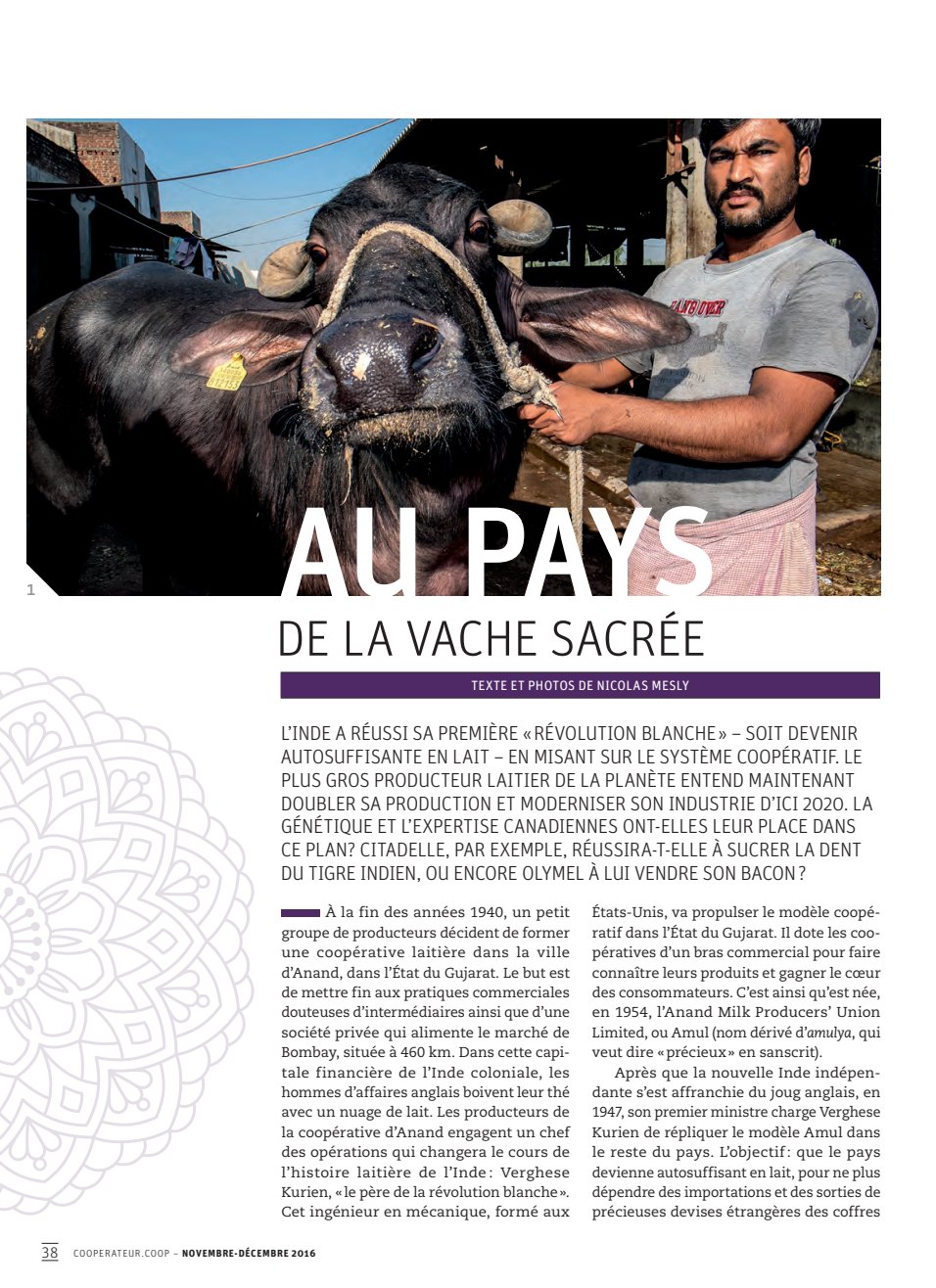
The objective is to make the country self-sufficient in milk, so as not to depend on imports and outflows of precious foreign currencies from the safes OF THE SAARCED VACHE 1 110028_Cooperateur_NOVEMBER16 STt.indd 38 16-10-28 14:47 39 COOPERATOR.COOP – NOVEMBER-DECEMBER 2016 AGRICULTURAL AFFAIRS − 1. India has the largest herd of buffaloes in the world. Milk contains 9% to 14% fat. 2. Cows in India are sacred!
The citizens pay for the cows to be fed good forage every day, a gesture that brings luck. 3. Amul butter produced in the factory of Anand is its flagship product. These small containers are found on board airlines. 4. The Managing Director of the National Dairy Development Board, Shri T.
Nanda Kumar, intends to modernize and double India's dairy production by 2020-21. 5. Indian bacon from Olymel? D years ago a country where meat consumption is banned for 20% of the population, who is Muslim, Jacques Pomerleau, former president of Canada Porc International, believes that as incomes increase, Indians want to eat quality meat, including Muslims. 6. Women like Mrs. Patel, member of Sandesar cooperative, will be at the heart of the modernization of India's dairy farming. 110028_Cooper_NOVEMBER16 STt.indd 39 16-10-28 14:48 40 COOPERATOR.COOP – NOVEMBER-DECEMBER 2016
Kurien founded the National Dairy Development Board (NDDB) in 1964, and among his geniuses, he financed the creation of a national cooperative network by selling milk powder from international aid to consumers in large cities. Local production replaced imports. This was called Operation Flood (the operation of abundance), which was carried out from 1971 to 1996.
The most ambitious rural development programme in the world, which catapults India as the world's largest dairy producer and provides it with self-sufficiency, has joined 73 0 00 cooperatives to supply its citizens with this essential, high-quality, affordable beverage.
Its 2010-2019 action plan, called NDDB Phase 1, is financed by the World Bank at a cost of US$350 million. Under this plan, Shri T. Nanda Kumar intends to almost double India's annual production to over 210 million litres of milk by 2020-2021. This is in a country where 85% of producers were two or three cows and own 75% of cattle.
To achieve its first objective, Nanda Kumar aims to improve the genetics of five breeds of dairy cows and five breeds of buffalo (India is the largest producer of buffalo milk on the planet). And to double the milk production per cow to over 2000 kg per year, it relies on the import of embryos and seed, a program of genetic selection of bulls and another aimed at evaluating the offspring of these bulls. The goal is to produce 100 million doses of seed with a group of 2500 bulls.
Canada is not competitive in terms of Holstein seed prices, but we have Canada in our radar for our Jersey-bred approval," says Nanda Kumar. "However, in a separate interview, Semex Canada's representative in India, Vimal Datta, says he has obtained L-INDE-LAITIERE n's largest milk producer in the world, India produces nearly 13% of the world's milk. n India wants to double its production by 2020 to reach 200-210 million tonnes of milk. n N cow shadow: 1 99.1 million; buffalo number: 1 05 million.
Total of 304 million cattle. n
Most of the milk is consumed on site, at home, or sold in villages. (Sources: FAO, BM, Amul, NDDB) L-INDIA, A AGRICULTURAL SUPERPUSSANCE n , India has almost three times the size of Quebec. n , India will exceed the population of China in 2050. n, India has almost as much cultivated land as the United States. n, 75 % of Indian producers own less than one hectare of land. n, India is the world's largest producer of milk, lentils and spices. n, India is the second largest exporter of beef (beef and buffalo), after Brazil and before the United States. n, the agricultural sector contributes 17.4% to the country's GNP. (Sources: F AS/USDA, World Bank) 1,110028_Cooperator_NOVEMBER16 STt.indd 40 16-10-31 10:54 41 COOPERATOR regularly.COOP was the last contract of which was US$2 million.
And the NDDB is working with a Canadian veterinarian, Dr. Gabriel Couto, to perform embryo transfer. In addition to genetics, Nanda Kumar is using a balanced ration to increase animal production. NDDB is developing a national feeding card "for every animal", by valuing local sources of supply and using a digital platform. The idea is to reduce feeding costs, which represent 60% of the cost of production on the farm.
With artifi - celle insemination and an appropriate ration, it is hoped to reduce calving intervals and remove non-productive cows from the system. From 20 to 30% of cows do not have calves, "they eat anyway," says Nanda Kumar. The latter makes a short parenthesis during the interview to indicate that the NDDB also focuses on animal health through a network of 200 veterinarians serving the whole country. Indian Immunologicals Limited, a subsidiary of the NDDB, is the world's largest manufacturer of foot-and-mouth disease vaccines, which are sold at half the international price.
The veterinary services offered to producers are free of charge. The Director General states that the second white revolution in India also involves strengthening institutions and educating producers. More than 100 0 00 of them are taking one-off annual trainings on animal health and food and on business management. He also states that the future of this second white revolution lies in the hands of women.
As men leave villages to provide labour to the manufacturing and service sectors, "agriculture is feminizing." One third of the 16 million members of the 200 Indian dairy cooperatives are women." 50% is targeted," he concludes. AMUL, THE QUEEN INDIAN LAITIER PLANET INDIAN INDIAN INDIAN INDIAN INDIAN INDIAN INDUSTRIAL INDUSTRIAL INDUSTRIAL INDUSTRIAL INDUSTRIAL INDUSTRIAL INDUSTRIAL INDUSTRIAL INDUSTRIAL INDUSTRIAL INDUSTRIAL INDUSTRIAL INDUSTRIAL INDUSTRIAL INDUSTRIAL INDUSTRIAL INDUSTRIAL INDUSTRIAL INDUSTRIAL INDUSTRIAL INDUSTRIAL INDUSTRIAL INDUSTRIAL INDUSTRIAL INDUSTRIAL INDUSTRIAL INDUSTRIAL INDUSTRIAL INDUSTRIAL INDUSTRIAL INDUSTRIAL INDUSTRIAL INDUSTRIAL INDUSTRIAL INDUSTRIAL INDUSTRIAL INDIAN INDUSTRIAL INDUSTRIAL INDUSTRIAL INDIAN INDIAN INDIAN INDIAN INDUSTRIAL INDIAN INDIAN INDIAN INDIAN INDIAN INDIAN INDIAN INDIAN INDIAN INDIAN INDIAN INDIAN INDIAN INDIAN INDIAN INDIAN INDIAN INDIAN INDIAN INDIAN INDIAN INDIAN INDIV INDIV INDI INDI INDI INDI INDI INDIV INDI INDIA INDIA INDIA INDIA INDIA INDIA INDIA INDIA INDIA INDIV INDIA INDIA INDIA INDIA INDIA INDIA INDIA INDIA INDIA INDIA INDIA INDIA INDIA INDIA INDIA INDIA INDIA INDIA INDIA INDIA INDIA INDIA INDIA INDIA INDIA INDIA INDIA INDIA INDIA INDIA INDIA I
Sodhi, has not changed its opinion since his shock speech at the International Summit of Cooperatives in Quebec City in the fall of 2014. No question for India to open its market through free trade agreements, whether with New Zealand, Australia, the United States or the European Union. "These countries have saturated markets and only want to sell their surplus in India, at a AGRICULTURAL AFFAIRS price."1 Cows do not always graze in the best pastures 2.
The Patel family is a member of the Sandesar dairy cooperative. Father and sons were five cows. Ketan, the son, did not intend to take over, but wants to go to study in the United States. 2 110028_Cooper_NOVEMBRE16 STt.indd 41 16-10-28 14:50 42 COOPERATOR.COOP – NOVEMBER-DECEMBER 2016 international that has dropped from $5,000 to $1,600 per tonne of milk powder," he says. For the general manager of Amul – a company that produces almost as much milk per year as Agropur, but with 3.4 million members compared to 3467 for the Quebec cooperative, that is a thousand times less – all the stake is at stake.
India is self-sufficient in milk thanks to 150 million small, marginal producers, who were two to four cows or buffaloes a day. These produce a production whose annual value, of C$100 billion, is greater than that of wheat, rice and oilseeds combined. Not a government, even that of the current neoliberal Indian Prime Minister, Narendra Modi, would risk playing its head by lowering the tariff lines of the dairy sector to provoke a white tsunami in the Indian countryside.
But does Amul not play double game? The Indian co-operative-vedette exports milk powder and various dairy ingredients to the Middle East, the United States and even New Zealand."Let's export only 1% of our production," says R.S. "Our market is India, the world's largest market, growing at a rate of more than 4.5% per year!"
What about the investment that Amul made in 2014 in the United States to operate a dairy plant in New Jersey? "It's not a big investment," says its Managing Director. "It's about offering dairy products to the three million or so Indian people in the United States."This strategic choice to produce in the United States is putting an end to the administrative harassment of U.S. customs over dairy products from India," he said.
But why not invest in Canada, with Agropur, rather than at Uncle Sam? "The Canadian market is saturated," says R.S. Sodhi, adding that he is very admired by the Quebec cooperative. WELCOME TO FOREIGN INVESTORS If New Delhi does not intend to play the free trade card, it welcomes foreign investors with open arms.
And these respond present. Danone, Fonterra, Cargill, Nestlé (the multinational has been active in India for decades) invest in the country to supply a market in full explosion. The rate of growth of the Indian tiger's GNP this year reaches 7.4 per cent, according to the World Bank. A new middle class of 350 million people creates demand partially met by fast food chains: McDonalds, Pizza Hut, Kentucky Fried Chicken.
"This is a welcome foreign investment," said R.S. There is room for everyone and it's good for producers!"This opening to international investment, introduced in 2010-2011, prompted Amul to leave his fief, Gujarat, to build processing plants in other states, including the Uttar Pradesh, India's largest milk producer. An increasing share of milk supply comes from outside Gujarat.
Sodhi says he is not afraid of competition, it is thanks to the cooperative formula and the strength of the Amul trademark. "I will never let Amul's members trade milk, as it was seen in China with the melamine scandal," he says. It would kill the golden egg chicken: A mul pays to the producer 0.80 rupees for each rupee spent by the consumer. Amul is inscribed in Indian DNA.
Discreet on its research and marketing budget, R.S. Sodhi indicates that the cooperative markets about 100 top quality products, adapting to the taste and trends of consumers: chocolate, lactose-free milk, cheeses, ice cream or yogurt with a thousand perfumes, etc. "I here, almond milk, is real milk to which a almond flavor is added," he says, smiles at the lips. The cooperative distributes its products in part through a network of 8500 kiosks scattered across the country.
DIRECT SUGAR AND PORC MEAT FOR INDIAN TIGRE "I imagine if each gulab jamun was bathed in maple syrup," said Antoine Pfister, who has been responsible for developing the Indian market for three years on behalf of the 2000 producers of maple syrup owners of Citadelle. The gulab jamun is a small fried donut, made of bread and milk mite, bathed in cane sugar and whose Indians are fond of. LAITIER FOREIGN INVESTMENTS IN INDIA ... n E No 2011, the US investment fund Carlyle Group purchased 20% of the shares of the Indian dairy company Tirumala.
The company is transforming 1.2 million litres of milk per day in three states: Andhra Pradesh, Tamil Nadu and Karnataka. n E n 2012, Danone also announced an investment in Tirumala. n R abobank, a global financial cooperative based in the Netherlands, invested US$18.5 million in the company Prabhat Dairy, located in the state of Maharashtra, in 2012 through its Agribusiness Fund investment fund. n R abobank injected another US$12 million into Prabhat Dairy, and Proparco, a French investment company, invested 9 million in the same company in 2013. (Sources: GRAIN "Defending people &s milk win India", January 2014))
Sodhi with his spiritual father Verghese Kurien, the father of the Indian White Revolution, in the background. 110028_Cooper_NOVEMBER16 STt.indd 42 16-10-28 14:53 43 COOPERATOR.COOP – NOVEMBER-DECEMBER 2016 LAITIAN INVESTMENTS IN INDIA [SUITE] n This investment is made in the wake of the arrival in India of fast food chains. Present in this country since the late 1990s, McDonalds has been associated with the American Schreiber Foods and with the Goenka Indian family to form Schreiber Dynamix.
The company supplies Danone, Nestlé, Yum and KFC. n L has the largest dairy company in the world, the New Zealand cooperative Fonterra, has established a joint venture with Indian Farmers Fertiliser Co-operative Limited (IFFCO) and Global Dairy Health (GDH) to operate a 13,000 cow farm in the Nellore Special Economic Zone, Andhra Pradesh. (According to a safe source, the project has aborted because cows could not be eliminated after their working lives. The cow remains a sacred animal in India.) n L e goliath agri-food Cargill invests in India through its Black River Asset Management fund.
In 2012, the company injected US$15 million into Dodla Dairy, also located in the Nellore economic zone. (Source: Grain) "India, it's Japan 30 years ago or China 15 years ago," added Philippe Leblanc, Director of Business Development at Citadelle. "The two men occupy one of the 21 booths in the Canadian Pavilion at the Aahar Food Fair, the largest event of its kind in Asia, which is taking place in the heart of the Indian capital, New Delhi. Of the 872 exhibitors, some came from 22 countries to titillate the taste buds of the Indian tiger, which is partly explained by the shortness of the Chinese dragon.
While cranberries are crunching, both representatives of Citadelle say they are targeting the high-end market of large cities such as Delhi, Bombay or Bangalore. India's economic boom is encouraging the development of a young middle class, who travels and is more aware of the importance of healthy foods: u n a basin valued at 350 million consumers, the size of the United States! Or the natural virtues of maple syrup, the two businessmen intend to promote atocas (Citadel acquired in 2011 the Bergevin House, which produces cranberries).
Citadelle is the only Quebec company to have a flesh and bone representation in Aahar. At the Canada Pavilion, four companies left documentation. However, this may be a blow to the water. According to Parthi Muthukumarasamy, a commercial attaché specializing in agriculture at the Canadian High Commission, Indians attach great importance to personal relationships, hence the importance of having a representative on the spot or visiting his contacts regularly in India.
According to this expert, Quebec companies such as Biscuits Leclerc, which offer a quality product that is not found in India, would have a great chance of cutting off a share of the Indian tiger. Red beans and organic soybean exporters would also find their own account in this country. Joined the telephone, Canada's former president Porc International, Jacques Pomerleau, indicates that he has been snatching his strategy outside of Aahar. He said he worked tirelessly to allow Canadian pork to cross the tariff and non-tariff barriers of the Indian tiger in 2016.
In a country where consumption is banned for 20% of the population, which is Muslim, and where the Hindu majority is highly vegetarian, is selling pork a madness? "Not all Indians are vegetated - nothing by choice," says Jacques Pomerleau, who visited India twice. "As their incomes increase, they want to eat quay meat, including Muslims."I estimate that 60 million people are the population that can eat Olymel bacon.
It's more than the Canadian population! Québec Agriculture and Agri-Food Reference Centre 418 523-5411 • 1-888-535-2537 Producers? Register for the event and take the chance to win a pair of tickets for Montreal Canadians in Desjardins Lodge! REGISTER AT CRAAQ.QC.CA/CRAAQ-CREAK EVENTS November 18, 2016 Lévis Convention and Exhibition Centre Preferential rate until November 4, 110028_Cooper_NOVEMBER16 STt.indd 43 16-10-31 13:51
Complete original publication
The complete facsimile presents the publication in its original editorial design.
Open original PDF ↗