The complete story
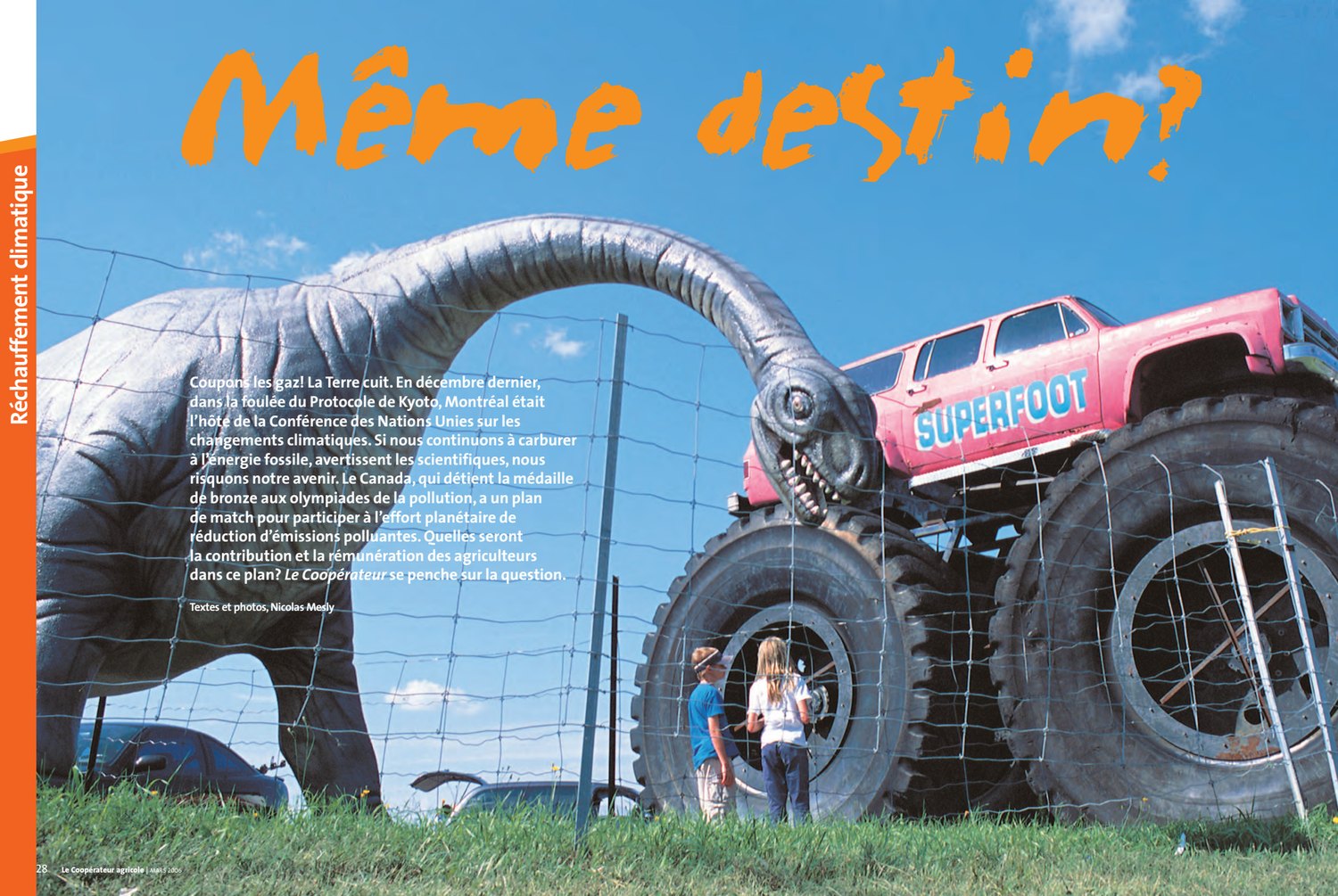
Destiny?Even Climate Warming Cut the Gas! Last December, following the Kyoto Protocol, Montreal hosted the United Nations Climate Change Conference. If we continue to carbide with fossil energy, warn scientists, we risk our future. Canada, which holds the bronze medal at the pollution olympiades, has a game plan to participate in the global effort to reduce polluting emissions.
What will farmers' contributions and compensation be in this plan? The Co-operator is looking at the issue. T exts and photos, Nicolas Mesly 28 The Agricultural Co-operator, MARCH 2006 even by immediately meeting the targets for reducing greenhouse gases in the Kyoto agreement, the temperature will continue to rise. Better to solve and adapt!', predicts Philippe Rochette, agrometeologist at Agriculture and Agri-Food Canada's Soil and Field Crop Research and Development Centre in SainteFoy.
Rochette joins the international scientific community whose computers pre-view an alarming climate scenario to varying degrees. Quebec's higher temperature, 30-day extended growing season, and 600 UT increase in the Montreal area, would increase corn yields from 9 t/ha to 14 t/ha in 50 years. And those of the Gaspésie and Lower St. Lawrence would be comparable to those of Montérégie today. Soybean yields would increase by 1 t/ha.
Producers could also add an extra alfalfa cut to their schedule. However, the researcher warns that not all plants respond favourably to an increase in temperature. This is the case for barley "who does not like heat." These forecasts of increased yields, admits the researcher, do not include the presence of new pests or diseases capable of sabotage a harvest or do not take into account the capacity of soil water retention, because if "precipitation does not change much, a higher temperature increase will cause a little more evaporation".
Nor does these predictions take into account the moods of the new milder winters and the lethal frequencies of frost and thawing."When we remember the winter 1981-82, 50% of the apple trees had made the soul!" he said. Less snow also means a thinner cover against the cold. For forage plants, including the frileous alfalfa, it can be deadly!
"The climate change that will take place over the next 50 years will be gradual and farmers have always been able to ssssssadap - ter," says Susan Béliveau of the University of Guelph, who is working on climate change risk management with two producer groups, one in British Columbia and the other in Ontario. "If producers west of Quebec also applaud the increases in thermal units and longer growing seasons, some orchards and plants may be very thirsty because of, among other things, "the disappearance of glaciers that supply water to the Okanagan Valley orchards."
For some companies, water and irrigation will be synonymous with survival, as the number of summer heats and winter thaws may increase. The strategist, Susan Béliveau, recommends diversifying farm production to spread the risks."Producers rely heavily on biotechnology to develop seeds and plants adapted to these changes," says the specialist. "And farm services will also have to adapt to damage.
"The Innovative Farmers of Ontario Group has negotiated with its supplier the possibility of changing seed varieties at half prices in case of a bad spring." Over the past five years, this unwritten risk-sharing legislation between producers and suppliers has also been in place in Quebec. Harvest insurance is also likely to be jammed, which would affect producers' income."The second seed in the spring often results in lower harvest yields in the fall.
A single bad spring would help reduce financial compensation to producers, as it is based on returns from the previous five years," says Béliveau. "Researcher Philippe Rochette, meanwhile, qualifies as an optimist and expects that the benefits of climate change will be greater than the risks to Quebec agriculture. However, if we are "ga-gnants", he recalls, our agriculture is part of a "complex global system."
And there will be losers. The rise in temperature on the planet will cause, among other things, an increase in ocean levels and more frequently, violent natural phenomena like El Niño or tsunamis. And the poor countries, the most vulnerable, are the first to be caught. The United Nations is planning a drastic increase in environmental refugees and food crises in Africa, a continent that is not responsible for greenhouse gas emissions. 30 The Agricultural Co-operator − MARCH 2006 The Quebec of tomorrow will be Pennsylvania today!
In 50 years, from 2 °C to 4 °C more winter and from 1°C to 4 °C in summer. Not yet enough to grow palm trees. But, nevertheless, from grain corn to Gaspésie and yields of 4 to 5 tons more per hectare! Luzerne and soya will also grow to heart.
New vineyards and orchards will emerge from the ground! L'orge, among others, will suffer. Should we rejoice at climate change? Photo: biScione Photo: biScione Climate warming Distribution of Quebec greenhouse gas emissions in 2000 (%) 32.5 13.5 9.5 38.0 5.8 Transport Industry Non-industrial heating Agriculture Waste Electricity 0.4 Agricultural sources of Serre gas Animal production53% Plant production30% Fossil fuels14% Agricultural sources of greenhouse gases MARCH 2006
There is nothing to distinguish this stable from another, except that at each interval of three cows, a probe hidden on the ceiling measures the rots of animals, which account for 85% of the amount of methane (CH 4 ) emitted by ruminants. The probes, which take a measurement of ambient air day and night every 10 minutes, are connected to a central computer. The purpose of this experiment is to determine the amount of methane produced per kilogram of milk. Methane, 21 times more harmful than CO2, is one of the main greenhouse gases (GHGs) responsible for climate change on the planet.
"We are participating in this experiment to find out where we are going to go to agriculture. Are we polluating more or less with 50 cows that produce 10,000 kilos of milk or 90 cows that produce 8000 kilos of milk?" asks Diane Groleau, co-owner of the Jean-Noël Groleau Farm. On the roof of the barn, a small weather station also captures all the moods of Lady Nature to understand the influence of the north wind or the humidity of summer on the methane rate in circulation in the building.
"The goal is to quantify the production of methane from livestock in Quebec," says Daniel Massé of the Centre for Research and Development on Dairy Cattle and Pigs of Agriculture and Agri-Food Canada in Lennoxville. "The Canadian government has committed to legally reducing its GHG emissions under the Kyoto Agreement, ratified in 1997 and which became law in 2005. Agriculture accounts for 10% of the country's GHG emissions. According to Ottawa's Green Plan, GHG reductions on the farm, through best farming practices, can be sold as carbon credits to both COUPONS AND GAS!
Emie Désilets, Coordinator of the Dairy Farmers of Canada's GHG Mitigation Program, is with Anass Soussi-Gounni, inventor of the biofilter installed on the Groleau farm that captures methane emissions from the pit. The name of the bacteria in the biofilter is kept secret, as the process is being patented. The filter is made of peat that can be spread on fields without problems after five years of service. Climate heating Claudia Bluteau, engineer, accounts for CH4 emissions produced at the barn 24 hours a day.
Cows have an ox effect on GHG production! C Groleau measure the rots of their cows! 34 The Agricultural Co-operator, MARCH 2006 Federal government that has major final emitters (GEFs): oil, cement, etc. Less than one hundred of these GEFs are responsible for almost half of the GHG emissions in the country. The experience begun in Groleau in July 2004 is in its first phase and is also taking place on another dairy farm in Quebec. Today, we know that a cow produced between 450 and 600 litres of methane per day, "equivalent to an ordinary car that runs 14,600 km per year" 1!
And the first way to control these methane emissions will be to trade in animal feed."If, for the same quanity of food absorbed, a cow produces more milk and less methane, it could be profitable for the producer," says Daniel Massé. "Researchers from Quebec, Ontario, Nova Scotia and Alberta will try to pore food oils, fats, methane inhibitors, new fodder to create a more "eco-friendly" future menu.
The scientists estimate that they can reduce methane emissions per cow by 10% to 20%, or about 100 litres per animal! At present, it is difficult to estimate this reduction in methane in litres of milk.
The nearby manure pit is sealed hermetically with a geotextile membrane. Here, the second major source of methane emitted by cows is measured, the manure. The methane produced in the pit is transported into a biofilter where it is decomposed into CO2 thanks to the work of specialized bacteria. A very eco-friendly process, according to Daniel Massé.
"The plant absorbs CO2. The cow digests the plant and, by ruminating, produces CH2. The biofilter, on the other hand, transforms methane into CO2. We completely recycle our CO2 molecule!"
The first phase of the current Groleau project, which required an investment of $150,000, will end in May 2006. Massé hopes to obtain new funding to launch a second phase of research, which would allow the development of a means other than biofilter to dispose of the methane produced in the slurry pit, this time by burning this gas."At present, the installation of a tor - expensive cost $20,000 to meet the Canadian standards that are designed for residences.
The Americans have developed flares for the agricultural sector, which cost between $200 and $300 a unit, and which are used, among other things, to dry grains."Massé concedes that the volume of manure produced by the 120 cows in the Groleau, unlike the gigantic Californian farms, would not allow to heat a building or dry grains on the farm.
First, the pit is emptied twice a year, in spring and autumn. And in winter, the bacteria that break down the manure refuse to work when it does – 10°C. But what is important is to find an economic way to reduce methane production. A federal methodology for quantifying and certifying on-farm carbon credits was to begin in January 2006, but elections delayed the establishment of the rules of the game.
"There is still no idea of the cost of gistration per tonne of carbon for GHG reduction projects. Is it worth registering with authorities individually or collectively?" said Émie Désilets, Coordinator of the Canadian Dairy Farmers' Greenhouse Gas Mitigation Program (GAAP). Another big unknown is the price per tonne of carbon per se, since the Canadian CO2 market has not yet started."It is not clear whether this price will justify on-farm investments.
At the moment, profits are not in carbon credits, but in improving the efficiency of certain farm practices such as food," says Émie Désilets. 1 Rochette, Philippe. Agriculture sources of greenhouse gases (GHGs) in Canada, Agriculture and Agri-Food Canada, Sainte-Foy, 2004. Climate warming Diane and Jean-Noël Groleau. "We are recovering and recycling much more than urban residents.
This experiment will give us just an hour about our contribution to GHGs and the possible economic benefits of these emissions." The more a company waits to reduce its emissions, the more expensive it costs. The price of the tonne of CO2 in the European market has increased from about $2 to $40 in a year! Not to mention the penalties of $64 per tonne for anyone who dumps its quota.
With this carrot and stick system, Europe is putting on a sustainable green coat. Canada, the first of its class, has been ranked last for its non-compliance with its Kyoto commitments. Since 1990, the baseline date for implementing the agreement, its emissions have increased by 33%! The country will therefore have to reduce its emissions by 270 Mt CO2 per year between 2008 and 2012, otherwise it will face very salty fines.
And, according to Paule Halley, Canada Research Chair in Environmental Law, University of Laval, the recent election of Canada's commitment to Kyoto represents 94% of 1990 emissions GHG emissions (equivalent to millions of tonnes CO2 )1000 1990 1995 2000 2005 2010 (EC, 2002) 607 726 810 570 Difference: 240 to 300 Mt 36 Agricultural Co-operators - MARCH 2006 MARCH 2006: Agricultural Co-operator 37 thanks to the creation of a carbon credit exchange, agricultural producers will become in addition to environmental service providers," says Carol-Ann Brown of Climate Change Central, who was organizing a seminar on the economic potential of climate change in agriculture in Calgary, Alberta, just before Montréal hosted some 10,000 delegates to the UN conference on global warming last December.
National Emissions Quota System: two familiar resonance tools for Canadian farmers, tools that are also at the heart of Canada's strategy and the 35 other industrialized countries that are signatories to the Kyoto Protocol, aimed at reducing greenhouse gases (GHGs) that cook the Earth.
The European stock exchanges, which started in January 2005, are now operating as a debit and credit bank account. If a country or company exceeds its emission quota or "polluting right", it must buy CO2 credits from the stock exchange.
However, if it produces less than its quota, by investing in new green technologies, it can sell its GHG savings or "carbon credits." A credit equals the equivalent of one tonne of carbon (CO 2e). Because, if CO2 warms the world, two other GHGs are more dangerous, namely methane (CH4) 21 times more harmful than CO 2 and nitrous oxide (N2O), 310 times more harmful than CO2! Climate warming price!a pollutionThe "G CO2 stock exchange and quotas to save the planet? Conservative government of Stephen Harper does not change its legal obligations, "Kings fall but the crown remains."
One of the Canadian carbon credit trading exchanges, which was scheduled to start in Montreal in January 2006, is still in the gaseous state. However, it is expected to allow the federal government and major Canadian final emitters (FEMs) to trade and buy these "pollutant rights" both domestically and globally. These FEMs are the producers of energy – oil, gas, electricity –, cement plants and transportation. There are all the heavy goods vehicles in the economy: Alcan, PetroCanada... Fewer than a hundred of them produce 85% of the GHGs attributable to FEMs.
Agriculture accounts for only 10% of the country's GHGs and the sector does not have mandatory reduction quotas in the Ottawa Green Plan announced in April 2005, but by adopting best farming practices, farmers will be able to produce and sell carbon credits, both to the GEF and to Ottawa, in two ways. The first, by reducing GHGs produced by their business. The second, by trapping GHGs in soil or in forests.
Because the federal government, in order to meet its legally ratified Kyoto commitments, will also have to buy these famous carbon credits both in Canada and abroad with a $1 billion Climate Fund. A sum that will rise to $4 or $5 billion by 2012. Hence the big question: Will the future sale of these credits improve producers' income? "Our land can serve as a carbon sink because plants absorb CO2 or store in organic matter," explains Edgar Hammermeister, director of the Saskatch - wan Soil Conservation Association, a province that houses half of the arable land in the country.
Last year, 210 farmers committed to direct seeding for three years by participating in Environment Canada's Pilot Emission Elimination and Reduction and Learning Project. The federal government is offering $11.08 per tonne of CO2 sequestered, but Ontario producers received $1.88 while Prairie producers harvested up to $5.43. Calculations are based on CO2 retention capacity of soils.
This will result in 53,000 tonnes of CO2 being sequestered and released into the atmosphere. "Quebec producers are expected to join this year," says Hammermeister. 1 Mulhern, Mike. "Climate Change", Better Farming, June-July 2005. Photo: LA cooP fÉDÉÉÉÉE Réhâblement climatique During his visit to the Palais des Congrès de Montréal on December 9, 2005, the former President of the United States, Bill Clinton, launched a vigorous plea for a new economy based on renewable energies: wind, solar, hydrogen.
"If we don't do anything, in fifty years, our next meeting here will be on a raft!" concluded Clinton. "L'oncle Sam is responsible for the quarter of global greenhouse gas (GHG) emissions that, according to a majority of scientists, melt the ice from the two poles of the planet. During Paul Martin's reign, Canada has moved from the top to the bottom in the Kyoto class."We haven't done what we had to do," said the former Prime Minister to the international press.
Politicians are passing by and the planet continues to heat. Left to right: Former Canadian Minister of Environment Stéphane Dion, along with Elisabeth May, Sierra Club Canada, Steven Guilbaut, Greenpeace Canada, and Jennifer Morgan of WWF. MARCH 2006: Agricultural Co-operator 41 "The federal government has taken our land hostage to reduce its national CO2 emissions inventory without compensating us for our sustainable cropping practices," said Leo Meyer, a grain producer from Woking, Alberta.
Moreover, the promise made to the GEF by the former federal Minister of the Environment, Stéphane Dion, that the maximum price to pay for the purchase of carbon credit would be $15 per tonne, leaves a bitter taste. "This is not a market price, it's a political price! Otherwise, several oil companies would have moved their billionaire oil sands projects. The price of the tonne of CO2 should be around $50 to force our economy to take a real green turn," says Meyer.
The GEFs produce 135 Mt CO2, which is half of Canada's 270 Mt annual reduction commitment. However, according to the Ottawa Green Plan, their emission reduction quota is 45 Mt. According to Agriculture and Agri-Food Canada's soil specialist Philippe Rochette, the total potential of Canada's agricultural land that can act as a carbon sink is between 10 Mt and 15 Mt. A potential primarily located in western Canada, where direct seeding is practised.
According to the expert, if carbon credits are in the Prairie soil, in the east of the country, these credits are in the reduction of GHG emissions on the farm, especially in the treatment of pig manure. After wind coops, CO2 coops? "Don't sign up for fake credits! These are credits that are not science based or at least on quantification methodologies endorsed by the government!
Wait until the rules are clear!" warns Cedric MacLeod, coordinator of the Canadian Pork Council's Greenhouse Gas Mitigation Program. MacLeod is working on the development of the "Chemicals" produced by pigs as a possible source of income on the farm. First target: to improve the daily gain of animals by reducing raw protein in food, this means less nitrogen in manure. "For every pound of nitrogen, 1.25% nitrous oxide is produced, the most virulent of greenhouse gases."
Second target, to cover pits to produce methane."Anaerobic digestion encourages the production of biogas that can be used to heat buildings." Burning methane reduces the risk factor from 21 to 1. MacLeod indicates that a GHG quantification protocol is being developed so that farmers have a correct photograph of their farm "so that they can check the measures to be taken to reduce their emissions." 2 However, although the Canadian stock exchange is not yet officially launched, 350 western Canadian pig farmers have already signed carbon credit options with AgCert, one of three energy brokers surveyed in Western Canada.
The Florida-based company is counting on the reductions in carbon emissions from spring application to the farm."Silver produces less GHGs applied early to fields than if it fermented in a pit or lagoon until autumn," says Chris Bolton, emission reduction specialist at AgCert. "We have not signed an option with Quebec farmers because provincial law requires them to empty their pits in the spring, which is not the case in other provinces," says Bolton.
To be certified by the responsible Canadian authority, any emission reduction project must change cropping practices and also have started after 2000. AgCert has already contracted Brazilian farmers by installing methane burning technology to recover carbon credits from some 30 farms. Brazilian potential is salivating. In Minas Gerais alone, 3.4 million pigs produce 7 million tonnes of manure.
As for CO 2e, another energy broker based in New York, the latter has already contracted AgroSuper, the largest producer of Chilean pigs, who invested US$30 million to recover the methane from its 100,000 pigs by covering 2 Same and interview with Cedric MacLeod, November 22, 2005. Climate warming According to the Bush Administration representative, Dr. Harlan L. Watson, the US has reduced the intensity of its total GHG emissions from 15% to 12% from 2000 to 2003, and invested more than US$5 billion annually in science and technology, "more than any other country."
There is a carbon exchange in Chicago, but there are no emission quotas. In the USA, GHG reduction efforts are voluntary. Thomas Mulcair, former Quebec Minister of the Environment, wanted to reduce GHGs by 20% by 2015.
The latter required $328 million in Ottawa to complete its plan. Greenhouse gas emissions per capita Australia United States Canada New Zealand Germany United Kingdom Japan Per capita emissions (tonnes CO2) membrane pits. Each tonne of methane recovered is equivalent to 21 RECs (certified emission reductions) or the equivalent of 21 tonnes of CO2. The sale of these credits to a Canadian ETF, TransAlta, will enable the Canadian ETF to achieve its reduction quota.
The price of carbon credit has not been announced, but it is the largest transaction under the Clean Development Mechanism (CDM), another tool developed under the Kyoto agreement that encourages companies from the signatory industrial countries to invest in sustainable development projects in the third world. 3 "In Quebec, a bank has already launched the ball to pool the credits of its pig farmers' customers to offer them to its large corporate clients, including Hydro-Québec," says Raymond Leblanc, agro-environment advisor to the Fédération des producteurs de porcines du Québec (FPPQ).
The QPF has about 4000 pig producers who in 2005 produced more than 7.3 million animals."We are advocating a collective approach with a social license to operate rather than individual projects whose size is not large enough anyway. The only cost of registering and certifying credits is ruinous!"No one has yet thought specifically about the potential of carbon credits that can be generated by a Quebec farm.
The results of a GHG quantification research project launched last year in the pit of Eric Proulx, owner of a 2000-beast feeder pig farm "should be available by the end of 2006", says Daniel Massé, from Agriculture and Agri-Food Canada's research station in Lennox, City. However, the first observation is: "The pit releases very little methane in winter because bacteria do not work at -10°C."The main reason for this is to reduce my quantities of manure application and cut odours, although they are difficult to quantify," explains Eric Proulx.
Without a clear understanding of its GHG emissions, farmers are not currently seeing the potential benefits of a future carbon credit market. If the rules of this market are soon clearly established by the new Conservative government, producers may have an advantage in regrouping to sell their credits at a better price.After the birth of wind co-ops in 2005, will CO2 co-ops be pushed in 2006? 42 The Agricultural Co-operator - MARCH 2006 Climate warming A human face on climate change!
Like farmers, Inuit live outside. A handful of them have come to Montreal to witness the influence of climate change in their daily lives. The seal hunt season is short, as there are no more ice packs. The harvest of traditional berries is less, and new plants appear.
The food guard of the approximately 60,000 Inuit is decreasing and "We don't have Wal Mart," they say. For humanity, Inuit are "the canaries in the mine." Renewable energies, soon profitable? 3 Ontario Pork Industry Council. "Handling Pigs Waste Smartly," January 7, 2005.
MARCH 2006: The Agricultural Co-operator 45 By Suzanne Deutsch suzannedeutsch@videotron.ca ersonne loves extremes in climate."In agriculture, a year of drought is terrible, two years is almost intolerable, given to three years, several producers are bank-road," says Tim Nerbas, a soil conservation agronomist for the Saskatchewan Soil Conservation Association and cattle producer in the Saskatoon area. "This year, we had an extremely high rainfall rate, to the point that it is difficult to harvest.
But we must realize that extremes are also part of our climate. The data, which goes back to the end of the 18th century, show that the Prairies have already experienced a period of drought that lasted 30 years."Wyett and Marlon Swanson, producers of Provost, Alberta, have certainly not waited so long before they reacted.In 15 years, they have transformed their cereal farm, which has been established for three generations, into a cow-veal business.
The low rainfall, with all the consequences for a cereal operation, and the continued rising costs of fuel and additions, have motivated them to make major changes in the management of their business."The idea of developing an autonomous operation came in the 1980s. I wanted to find a way to lower our operating costs," Wyett explains. "The Swansons have therefore increased their beef production and developed a farming system that fits well in a sustainable agriculture context.44 Agricultural Co-operator - MARCH 2006 Climate warming P Our climate is naturally variable, as is evident from the fluctuations in the seasons from one year to another.
If you live in a warm and dry climate, you will adapt your crops accordingly. The same logic applies when you live in a cold and humid environment. But what if nature surprises you year after year? Marlon Swanson , Provost producer, Alberta Adapting its operation to climate change PhotoS: Lorne MccLinton 46 Agricultural Co-operators MARK 2006 This system, based on nutrient recycling, leaves the livestock with the task of "harvesting" forage and fertilizing the land.
The movements are choreographed to ensure a good distribution of manure. Almost all of their fields are alfalfa. Although most producers are reluctant to give only alfalfa to their animals, Swansons avoid problems through careful monitoring of their herds and by adding an anti-swelling agent in their drinking water. Oats and legume pods from a local processing plant provide a nutrient supplement to the herd and improve soil quality.
Instead of using wintering enclosures to remove manure, portable breakers, mounted on skates, are used to keep the herd "recycling nutrients," even in winter. Ends mechanical harvesting, manure to be collected, fertilizer application; operations requiring machinery have almost all been abolished. By mid-September 2005, the neighbour's grain, on the other side of the road, was still waiting to be harvested. Harvests were far from being completed in the Lloydminster area and there was little hope that they would be harvested before snowfall.
The quality of the grain was greatly deteriorated with the heavy rains received in the area. Swanson fields, green and supplied, were wonderfully well, as were the herd elsewhere... "There are still many opportunities in agriculture but we have to adapt, change our way of working, innovate," Wyett continues. "Removing nutrients to ship them to the four corners of the globe, and then investing incredible sums to put them back in place, it was possible when fuel was not expensive, but it is no longer the case today."
The Swansons' closed-cup system is virtually free from the weather and fuel price increases, and now plans to start processing and marketing their products directly. Climate variables have also had a big impact on Tim Nerbas's and his spouse's business plan."We didn't want our company to be vulnerable.
There will always be years of drought and years too rainy, we must be ready to live these extremes. So we have increased our livestock significantly over the last five years, to diversify and not just depend on the cultivation of cereals. Our goal is to achieve a certain financial balance between the two." Climate warming Tim Nerbas, a soil conservation agronomist for the Saskatchewan Soil Conservation Association and cattle producer.
Complete original publication
The complete facsimile presents the publication in its original editorial design.
Open original PDF ↗