The complete story
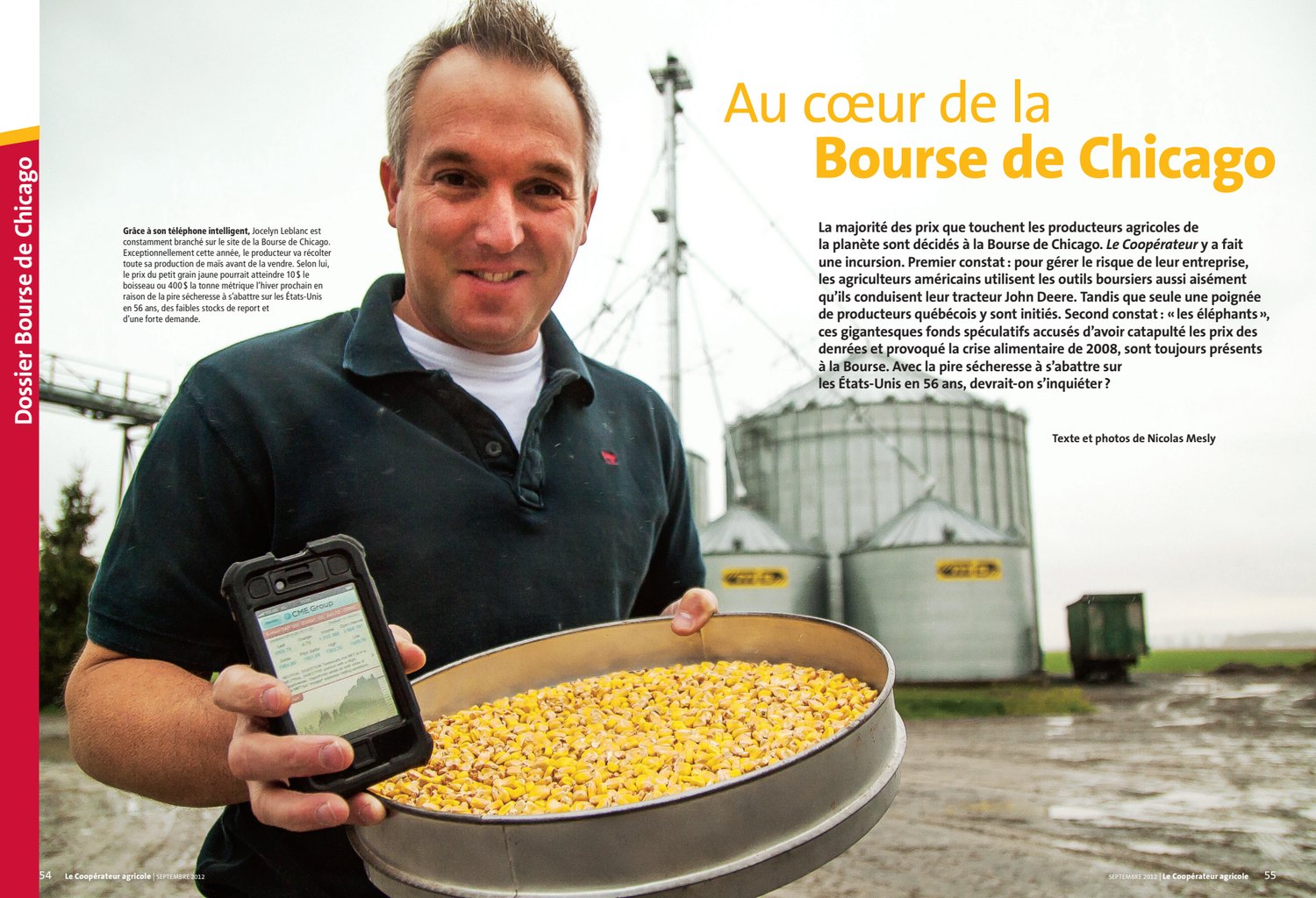
At the heart of the Chicago Stock Exchange The majority of the world's agricultural producers' prices are decided on the Chicago Stock Exchange. The Co-operator made a incursion. First observation: to manage the risk of their business, American farmers use stock exchange tools as easily as they drive their John Deere tractor. While only a handful of Quebec producers are initiated there.
Second, "Elephants", these huge hedge funds accused of catapulting food prices and causing the 2008 food crisis are still on the stock exchange. With the worst drought to hit the United States in 56 years, should we worry? Text and photos by Nicolas Mesly Thanks to his smartphone, Jocelyn Leblanc is constantly connected to the Chicago Stock Exchange site. Exceptionally this year, the producer will harvest all his corn production before selling it.
He said the price of small yellow grain could reach $10 per bushel or $400 per metric tonne next winter due to the worst drought to hit the United States in 56 years, low carry-in stocks and high demand. 54 Agricultural Co-operators EVERSEPTEMBER 2012 EVERYONE SEPTEMBER 2012 EVERYONE 55 File Chicago Stock Exchange Jocelyn Leblanc's Japanese candles At once harvested, the grain will leave the farm to be delivered to the buyer."Jocelyn Leblanc operates a family farm of 1,700 hectares of field crops on the edge of Saint-Hyacinthe.
"This year we are considering planting 600 hectares of soybeans and just as much corn." If much of the future soybean crop is sold, there is still no decision for corn."J" wait for prices to rise," says the producer, "American producers will sow less corn than the USDA would expect.
And low carry-in stocks will push prices up."The price is now about $5.20 a bushel or $205 a ton for delivery in December: that's the cost of production for Americans," he says. "And he believes that the price of the yellow grain will bounce between $7 or $8 a bushel, between $275 and $315 a ton. (In August, it was already done when the United States is experiencing its worst drought in 56 years.) Jocelyn Leblanc spends one hour a day reading reports, peeling market research and interpreting specialized graphs.
In addition to the Chicago Stock Exchange website, he draws information on the Federation of Commercial Crop Producers and even on American discussion forums such as AgTalk. He closely monitors the weather of the US Midwest, where 50% of the country's maize and 40% of its soybeans are produced. He also observes the situation in the producing countries of Brazil and Argentina. Futures contracts, a protection According to Jocelyn Leblanc, futures contracts (CAT) offered on the Chicago Stock Exchange are a formidable risk management tool, since the producer can protect himself from a decline or increase in the market, depending on whether he is a seller or buyer.
A future contract (also known as the "future") is defined as "a stand-alone contract - negotiated in an organized market to secure or engage in a price for a specified quantity of a given product at a future date." For example, by selling in May a CAT of 400 tons of soybeans to $14 per bushel for delivery by next November, "I undertake to deliver this volume of grain at that price in Chicago", n plant seeds of a value ranging from $500,000 to $1 million. For me, it is essential to know the selling price of my grains.
Without that, I am a pure speculator," says Jocelyn Leblanc, comfortably sitting at his desk, with eyes riveted on two computer screens. L-a displays prices for corn and soybeans on the Chicago Stock Exchange. The other, the report of the intentions of American producers published annually in March by the USDA (American Department of Agriculture), serves as a Bible for anyone trying to determine the price of grain around the globe.
Jocelyn Leblanc is a rare bird in Quebec. 40-year-old ITA graduate, Saint-Hyacinthe campus, has been following the Chicago Stock Exchange for some 20 years. We are on May 10 and he sold 40% of his soy crop before he even sowed. Jocelyn and his Quebec grain buyer agreed to a final price of $13.50 per bushel or $496 per tonne.
This final price is calculated from the market price on the stock exchange and the local market price. On the stock exchange on that day, the price of soy is $14 per bushel for delivery next November. But on the local market, the base is – 50¢. This base can be positive or negative.
It reflects the supply and demand of the local market, the costs of transportation, storage, interest and... the exchange rate. The final price of $13.50 is the price of Chicago plus the base ($14 + [– 50¢] = $13.50). Despite a negative basis, Jocelyn says: "I am very happy with my final price of $496 per tonne of soybeans. I cover my production cost and I do not have to pay any storage costs.
"O explains the producer."Of course, I'm not going to deliver this soy to Chicago. I'm going to liquidate my position on the Stock Exchange by buying my CAT on the day I sell my soy in the Saint-Hyacinthe area," he continues. "With this matching transaction between the Chicago Stock Exchange and the local market, whether the price of soy goes down in disaster to $4 a bushel or climbs to $17, Jocelyn is assured of getting $14 a bushel."
However, this stock market protection (hedging or counterpart) is only valid if "you do not change your strategy along the way to try to take advantage of an increase in the market," explains Simon Leclair, a marketing and risk management professor at the ITA campus in Saint-Hyacinthe. "If not, you are turning into a speculator! And you risk losing thousands of dollars. The magic figure is your production cost: you have to know it and sell your corn or soy above that cost."
The problem with CATs is that they are trading through a broker and that they need cash to own a brokerage account."It's important to warn your banker that you're doing hedging on the Chicago Stock Exchange," says the professor. "This is to clear a line of credit to protect you from a sale price or purchase of your goods.
The problem in Quebec is that very few bankers are familiar with futures contracts. In the United States, banks demand producers to protect their selling prices with CATs."Jocelyn Leblanc, with his eyes always riveted on the screen of his computer, analyses this time a chart of the price of corn. It is a rather old day at our meeting.
The huge seeder and tractor are locked in a large hangar next to the office. "You see, here, they are Japanese candles!" he explains by pointing the drawing. It is also about "crows" and "spinning stars." At this point, I learn that the price of corn can either dive or go up in arrows.
In its marketing strategy, the producer plans to secure through CAT the sale and price of one third of the 15,000 tonnes of grain produced on the farm. Despite all his expertise, the producer adds: "You are your worst enemy if you think you can predict the game of the stock exchange. The important thing for me is to secure a price that I believe is fair," he says, reiterating the advice of Professor Simon Leclair. According to Simon Leclair, professor of marketing and risk management, at the ITA campus in Saint-Hyacinthe, Quebec producers are much less familiar with the stock exchange tools than their American, Albertan and Ontario colleagues.
Interest is increasing, however, and over the past five years, 1,400 producers have been trained on the subject at ITA. The magic figure for using these tools, according to the professor, is its cost of production, which we need to know. Agricultural Financial says no to the stock protection 650 million $! This is the cumulative deficit of the Stabilization Insurance Fund of Agricultural Financial as of March 31, 2011.
Would the farmers' bank have a better interest in using stock exchange tools to minimize losses or make gains? According to La Financière agricole spokesman, Mélanie Fiset, three measures were taken in 2010 to limit the insurance coverage offered and the compensation paid to producers: • Reduction in the number of insured pigs – piglets outside Quebec. • Plafing of insured volumes by production sector. • Plafing of compensations that can be paid in one year.
For 2012–13, this limit was set at $650 million. "These measures make the use of tools such as term contracts unnecessary, especially as this would lead to additional costs," she explains. "The factors influencing the world commodity price • Climate (United States, Argentina, Australia, EU, Canada, Brazil) • Demand (China, India, Middle East, Russia, Japan) • World stocks • Oil prices • Currency play • Recession and financial crisis (e.g. 2008) • Retirement funds and sovereign funds • Ethanol production Source: Simon Leclair, ITA, Saint-Hyacinthe campus Types of buying or selling strategies • Spot, spot, • Forward, deferred delivery contract • Future contract (CAT) • Options Source: Simon Leclair, ITA, Saint-Hyacinthe campus "We live in a world where an Ethiopian grain trader bases the price of his wheat on that of the Chicago stock exchange." – Alan Bjerga SEPTEMBER 2012 - 1809. The first contracts were written for the Chicago stock exchange and the first contracts for the Chicago stock exchange.
The oats were then an important commodity. It was the feeding of horses. And the horses were propelling agriculture of the time, just before the industrial revolution!" explains David Lehman. In the 50s, this son of agricultural producer, an economist of training, is responsible for product research and the development of the stock exchange tools offered by the Chicago Mercantile Exchange (CME).
The interview takes place in a felted room on the second floor of the legendary Chicago Board of Trade building, located in the heart of the business district. Two or three times, the frenetic cries of brokers trading on the first floor of the parquet were almost interrupting the conversation. The pulse of the agricultural heart of the planet beats here. Maize, soy, turtle, beef, pork, cheese, milk powder, it is on the Chicago Stock Exchange, through the global supply and demand, that the price of the commodities produced by the agricultural producers worldwide is established.
To give an idea of the importance of this stock exchange, it negotiates more than 350,000 corn contracts every day, almost 15 times Quebec's annual production. Options, a more flexible tool Futures contracts (TCAs) have long been the preferred tool for farmers, grain traders or millers to protect themselves against fluctuations in market prices. But since its arrival on the Chicago Stock Exchange in 1984, David Lehman has been stung on a new risk management tool that has become very popular: options.
"The option is based on the same logic as home insurance to compensate you for a fire," says Mr. You will only receive insurance if your home burns. "If you have an option, you pay for an insurance that you will not get if the market price for corn or soybeans is higher than the price set. The option allows you to benefit from an increase in the market."
The options are now more popular with U.S. farmers than futures contracts (TCAs), because they are more flexible and require much less liquidity. Of course, the premium for this insurance will be higher or lower depending on the risk and volatility of the market. Yves Lamoureux, a term contract specialist at ScotiaMcLeod, says that the preference for options is also in Quebec. This broker manages the accounts of 250 customers.
ScotiaMcLeod, who has a gignon on street in downtown Montreal, is one of two agricultural brokerage companies in the Belle Province. Is it necessary to be big to protect himself on the Stock Exchange? Lehman, the size of agricultural companies counts to use the CME stock exchange tools. A corn contract has 127 metric tons, 136 for a soy contract.
To allow smaller companies to negotiate on the stock exchange, Mr. Lehman has created mini-contracts for agricultural products that are only one fifth of the normal "future" 25 metric tons of corn or soybeans. However, this market lacks liquidity, as it negotiates only 1000 of these mini-contracts per day. Another disadvantage: one cannot negotiate options with these miniature contracts.
To overcome this big problem, groups of Quebec producers are beginning to emerge. The goal: to bring together their grain offerings to protect themselves with Chicago stock exchange tools. "L Where to find information? • Grain Exchange, Chicago Mercantile Exchange (CME): www.cmegroup.com • Market information: www.fpccq.qc.ca and www.grainwiz.com • Graphs/products: www.finviz.com and www.barchart.com • Broker Source: Simon Leclair, ITA, campus of Saint-Hyacinthe At the top of the legendary Chicago Stock Exchange building is the statue of Ceres, the Greek goddess of agriculture.
Located in the heart of the Midwest, Chicago is at the crossroads of large waterways, such as the Great Lakes and Mississippi. The Chicago Board of Trade (CBOT) opened in 1848. It began as a sales auction for cattle and grain. In 2007, the CBOT was purchased by the Chicago Mercantile Exchange (CME) Group for $8 billion US.
In its early days, the CME was specialized in butter and egg futures contracts. But today, in addition to agricultural commodities, this group negotiates treasury bills, mortgages, currencies and a range of financial tools in a huge room that can house a Boeing 747. According to David Lehman, options are a risk management tool that should be of interest to Quebec producers. SEPTEMBER 2012的 The Chicago Agricultural Co-operator 59 Stock Exchange The Janor Group is familiar with the Jean-Marc Paradis Stock Exchange two years ago, by the Janor Group, to take full-time responsibility for the annual marketing of 10,000 bouvillons.
Jean-Marc recommends that you take training to understand the risk management tools offered by the Chicago Stock Exchange. Moreover, he says, it is important to understand the language of the brokers and the strategies they offer."Would you blindly entrust your portfolio to your neighbour?" he asks. Jean-Marc has developed his own model of analysis, which combines the price of calves, the price of corn and the exchange rate to decide the best selling price for the animals.
He spent an hour a day analyzing the mood swings of the Stock Exchange. Jean-Marc Paradis and Marie-Claude Mainville, of the Janor group Mr Ziegler, blamed without doubt these hedge funds for having caused the hunger riots in some 40 countries in 2008 (also FAO). And for having made the number of malnourished people of the planet to rise to more than one billion inhabitants.
In 1991, Goldman Sachs was planning to incorporate food into his risk portfolio. This was done with the blessing of the Commodity Futures Trading Commission (CFTC), a kind of American stock market broker. From now on, the world's big silversmiths could buy corn, wheat or rice contracts to make their accounts grow by speculating on people's appetite. To give an idea of their weight, from 2000 to 2011, the investments of the three bank elephants – Goldman Sachs, Morgan Stanley and Deutsche Bank in agricultural products – went from US$6 billion to US$340 billion, writes journalist Alan Bjerga in his recent book1.
The latter travelled the world to Africa to see the influence of the Chicago Stock Exchange in the daily lives of agricultural producers."At $5 a bushel, these large investment funds can buy all the American corn production, worth $65 billion, in a single click of mouse," explains Alexandre St-Jacques Burke. Formerly employed by La Coop federated in Montreal, this young broker is now working in Chicago for the investment company Infinium Capital Management. After the 2008 financial and food crisis, President Obama passed the Dodd-Frank law to limit the influence of these elephants on the Chicago Stock Exchange.
The CFTC has taken a few steps. "The same investor can never hold more than 33,000 futures contracts for corn, 12,000 wheat contracts and 15,000 soy contracts," says David Lehman, the product research and stock tool development manager at the Chicago Mercantile Exchange (CME). In other words, an investor can never own 1.5 times the annual production of corn in Quebec, 3 times the annual production of soybeans and nearly 11 times that of wheat. Lehman maintains that producers benefit from the presence of these elephants and benefit from better prices.
"Our analyses show that these speculators influence the price in the short term, but they withdraw from the market when the futures contract expires, leaving real sellers and users in the presence," he says. "The economist says that the presence of pachyderms calms the volatility of the market. And according to his studies, the fulcruming rise in food prices in 2008 was rather generated by an exacerbated demand from countries like China and India combined with cereal stocks at the lowest level in history.
The acrimonious debate surrounding the controversial presence of elephants on the Chicago Stock Exchange is re-launched with the worst drought to befall the United States in 56 years. The reduction in corn production in this country, the world's largest producer, will amputate the world's estimated grain production of nearly 2.4 billion metric tonnes by 23 million metric tonnes, according to FAO. The organization does not anticipate shortages of wheat (and of the FPPQ, a one-stop shop on the Chicago Stock Exchange "Thanks to the collective sales agency of pigs, our producers are given simplified access to risk management tools from the Chicago Stock Exchange," explains Eve Paré, director of marketing and economics at the Fédération des producteurs de porcines du Québec (FPPQ).
The organization has developed a deferred delivery contract (DTC), which allows small producers to take forward contracts from 25 to 80 head, while only one of these contracts requires a volume of 200 pigs. The QPF facilitates the lives of farmers by also managing the exchange rate risk. It also provides information.
"The stock jargon is translated so that the producer can easily compare it with its cost of production," says Paré. "The CDL system has been running since the early 2000s. It was interrupted twice, the last in January 2011, due to lack of liquidity to maintain a brokerage account. Talks to establish a credit line of several million dollars are underway with La Financière agricole.
Up to now, about 100 producers have negotiated LTCs, a very positive but marginal experience. The objective is to extend this risk management service to as many producers as possible. Agricultural Product Marketing and Risk Management Courses Contact: Richard Samson, Continuing Education Advisor,ITA, Saint-Hyacinthe campus Telephone: 450 778-6504, ext. 6267 Email: richard.samson@ mapaq.gouv.qc.ca 1 Endless Appetites: How The Commodities Casino Creates Hunger and Unrest, Bloomberg News, 2011.
According to Jean Ziegler, the poorest countries should not suffer the consequences of the volatility of the world price of products fixed on the Chicago Stock Exchange. Nations should decide themselves on the price of food, policies to support their agriculture and the management of their agricultural trade without being treated as renegade by the WTO. Elephants on the Chicago Stock Exchange are worth noting! There is quite legitimate market speculation, that of futures contracts," warns Jean Ziegler.
On a tour in Quebec last March to promote his most recent book, Mass Destruction: Geopolitics of Hunger, the former rapporteur for the right to food at the United Nations explains: "The Canadian wheat producer and the New York bakery chain will agree for example on a price that does their business in May, but the wheat will only be delivered after the harvest in September. It is not known what the market price will be at that time. There is a speculative element in this transaction. But on one side, the producer is assured of selling his grain at the desired price, and on the other, the baker knows the price of his raw material."
Ziegler advocates the ban on hegde funds, these large hedge funds created first by the great American bank Goldman Sachs. "We manufacture commercial papers that include food and sell ten times, a hundred times more expensive, and that break prices. But Goldman Sachs doesn't care about wheat or the problems of farmers like the year 40. It never delivers the goods.
The so-called financialization of the chain must be prohibited." "A What is a futures contract? • Legal contract • Standard contract (the only variable is price) • Buyer and seller have obligations (quantity, quality, place of delivery and month of delivery) Source: Simon Leclair, ITA, campus of Saint-Hyacinthe A futures contract • Corn: 5000 bushels or 127 tons • Soy: 5000 bushels or 136 tons • Wheat: 5000 bushels or 136 tons • Pork: 40,000 pounds • Beef: 40,000 pounds Source: Simon Leclair, ITA, campus of Saint-Hyacinthe 2008 2009 2010 2011 2012 900.00 799.40 700.00 500.00 500.00 300.00 600,000 0 -600,000 Sources: Finviz.com Elephants Small players Contracts of 5000 bushels rice) in 2012-2013 since global production and carry-in stocks will be sufficient to meet global demand.
Ziegler believes that governments should take measures to protect their populations from the extreme volatility of cereal prices, a phenomenon that is not ready to disappear. Corn prices / Presence of large hedge funds (US$) SEPTEMBER 2012
Complete original publication
The complete facsimile presents the publication in its original editorial design.
Open original PDF ↗